
The Hypermobile Pelvis - Why our muscles grip with hypermobility
Sep 21, 2026
Low Abs, Glutes & Stability Month
When ligaments have more give in a hypermobile body, the pelvis depends on muscles that quit under load. Gripping harder is the body's attempt fix and stabilize that — and the reason you're tight, tired, and still unstable.
By Ana Kokaurova, Certified Advanced Rolfer®, Stott-certified Pilates instructor, VASIE® Instructor Trainer · September 21, 2026 · 9 min read
The short version
The pelvis is held together two ways: by the shape of its joints and ligaments, and by muscles pressing the bones together. In hypermobility the first system does less, so the second has to do more — and the muscles best suited to that job are the small, reflexive ones. If small muscles are weak, they big ones start to grip, create tension and stiffness under load, speed, and full bodyweight.
The big hip muscles and the pelvic floor take over, grip constantly, and never quite manage it. The fix is not more strengthening. It is training two systems separately, at loads each can tolerate, so the deep one comes back and the outer one can let go.
The deep dive
Maren's hips were never relaxed
Maren was thirty-six when she started with us, with a diagnosis of hypermobile Ehlers-Danlos syndrome that had taken eleven years and six clinicians to get. Her sacroiliac joint "went out" every few weeks. Her hips were so tight she could not sit cross-legged, which confused everyone who knew she could put her palms flat on the floor. Her pelvic floor physical therapist had found that her pelvic floor was not weak but overactive — gripping all the time — and had told her to stop doing Kegels.
The pattern is this: a hypermobile client is often told to strengthen, strengthens diligently, and ends up tighter, more fatigued, and no more stable than before. Then they are told they have poor body awareness, are anxious. If you fit into this group, your body is telling is telling you something is unsupported.
How a pelvis holds itself together
The sacroiliac joints — where the base of the spine meets the two halves of the pelvis — are stabilized in two ways, and the distinction matters enormously if you are hypermobile.
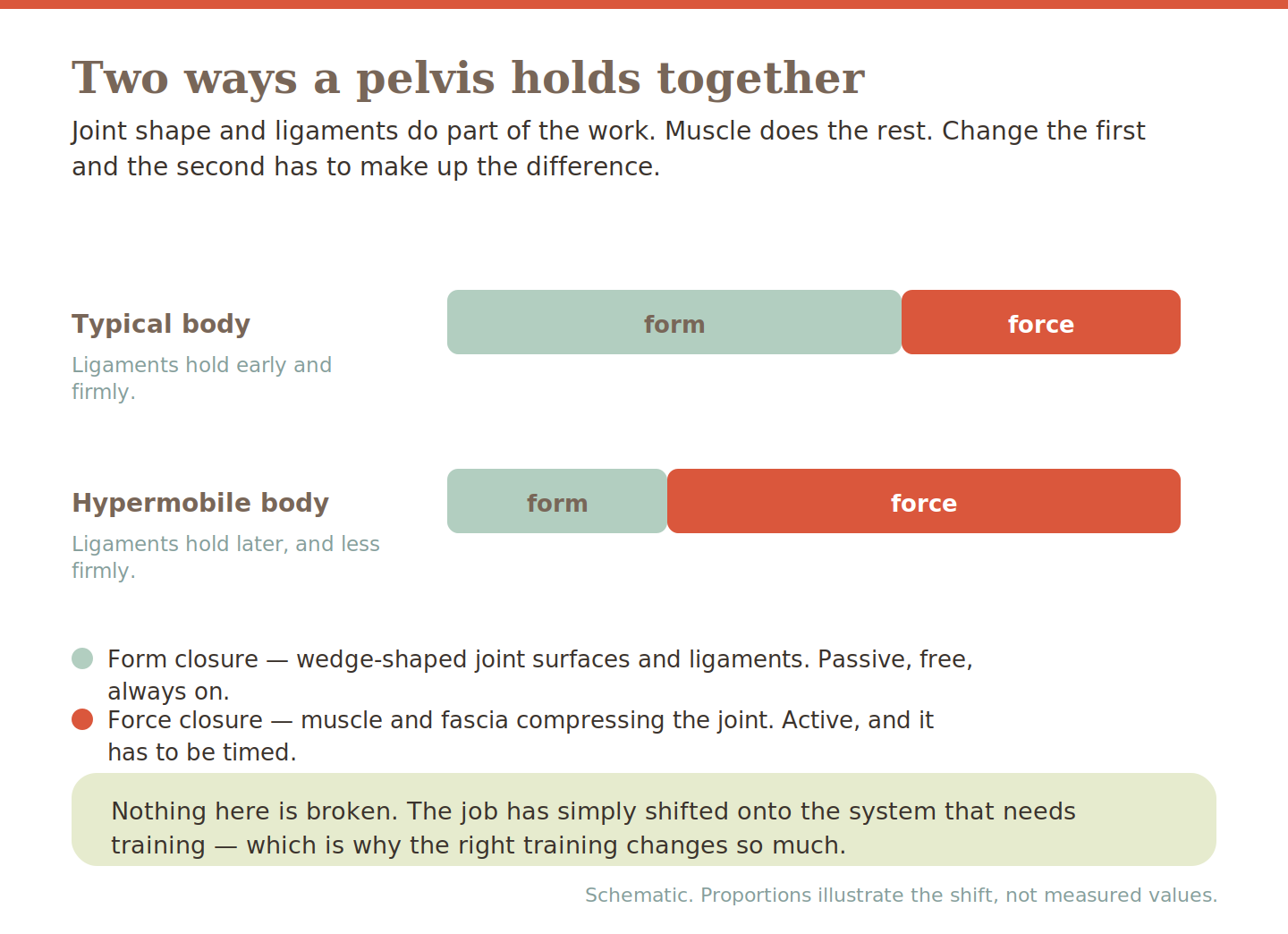
The first is form closure: the joint surfaces are wedge-shaped and ridged, and a dense web of ligaments binds them. In a typical body this passive architecture does a large share of the work for free, and the joints move only a few millimeters.1
The second is force closure: muscles and fascia compress the joints from outside. The most efficient contributors are the deep system — the transversus abdominis wrapping the waist, the multifidus along the spine, the pelvic floor below, the diaphragm above — tensioning the thoracolumbar fascia across the back of the pelvis like a cinch strap. These are reflexive muscles. In a well-organized body they switch on a fraction of a second before load arrives, without instruction.
Now change one variable. Make the collagen more extensible, as it is in hypermobility spectrum disorders and hEDS. Form closure drops. The ligaments still hold, but they hold later and less firmly. The pelvis now depends more heavily on force closure — on muscle — than it was designed to.
The muscles that should help are the first to quit
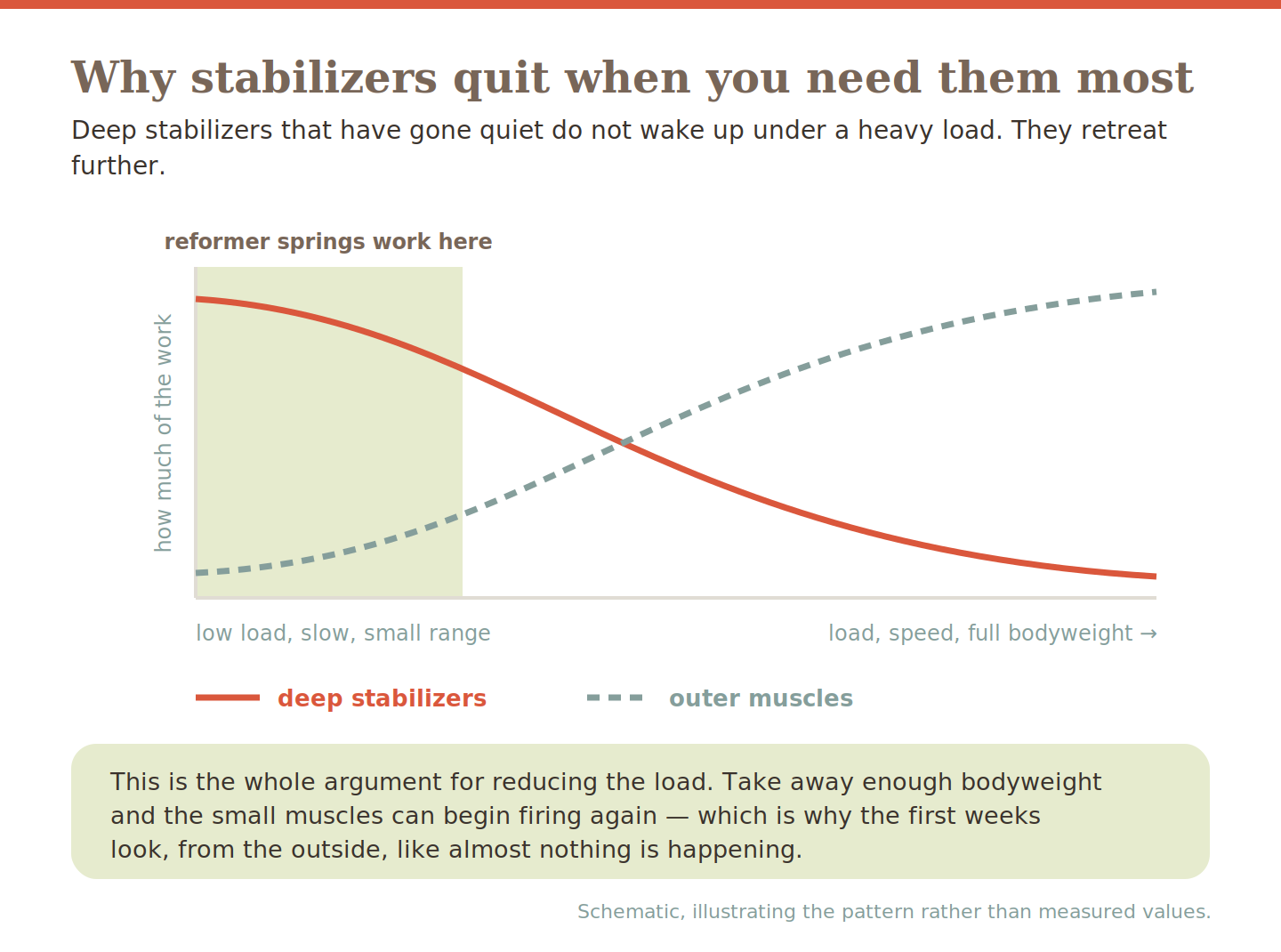
Here is the part Maren had never been told. The deep stabilizers that are best at force closure are also the muscles most likely to shut down under load, speed, and full bodyweight. When they lose function they do not re-engage under demanding conditions; they retreat further. Hypermobile bodies also tend to have less precise joint position sense, so the reflexes that should time these muscles have poorer information to work with.2
The nervous system does not tolerate an unstable pelvis. If the deep system is late or quiet, something else is drafted. In Maren's case, and in most hypermobile clients I have worked with, that something is the outer system: gluteus maximus and the hip rotators, the adductors, the hip flexors, the obliques, and the pelvic floor working far above its resting tone. These muscles can compress the pelvis. They do it by gripping. They are designed for movement and power, not for standing guard all day, so they fatigue, shorten, and ache — and because they are less precise than the deep system, the joint still feels loose underneath the tension. Clinicians who classify pelvic girdle pain describe this excessive-bracing pattern as a distinct problem from a weak one, and note that it calls for a different approach.4
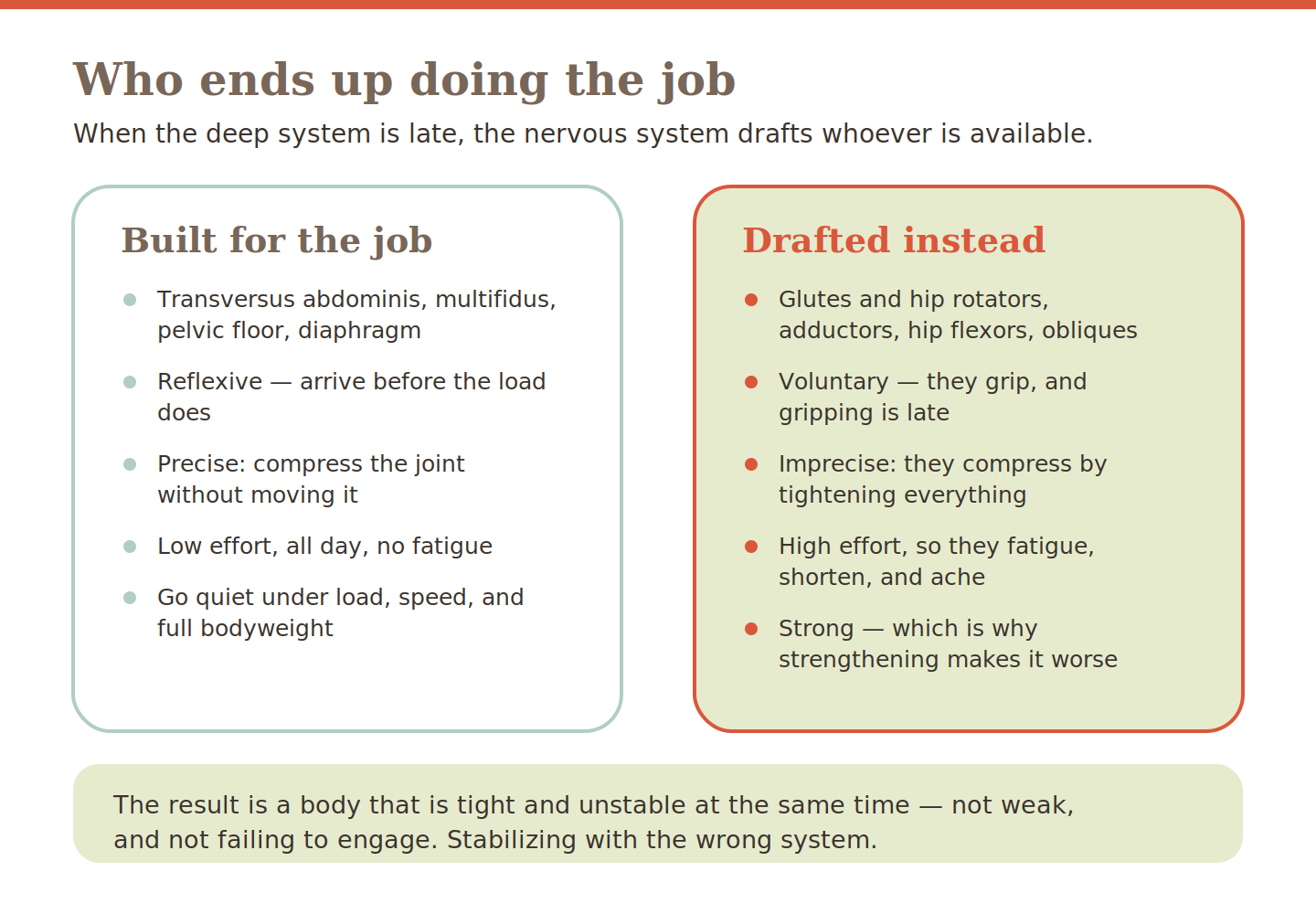
Tight hips that are also unstable. A pelvic floor that is clenched and still not doing its job. An SI joint that shifts despite a strong body. Maren was not weak, and she was not failing to engage. She was stabilizing with the wrong system, and every strengthening program she had tried loaded that system harder. Pelvic floor and pelvic girdle problems are common in hEDS and hypermobility spectrum disorders,3 and I believe this substitution pattern is a large part of why.
Why one workout can't fix this
The fourth of the six VASIE® differences is the one this problem needs: two workouts for two muscle systems. We do not try to train the deep stabilizers and the outer movers in the same exercise, because they want opposite conditions.
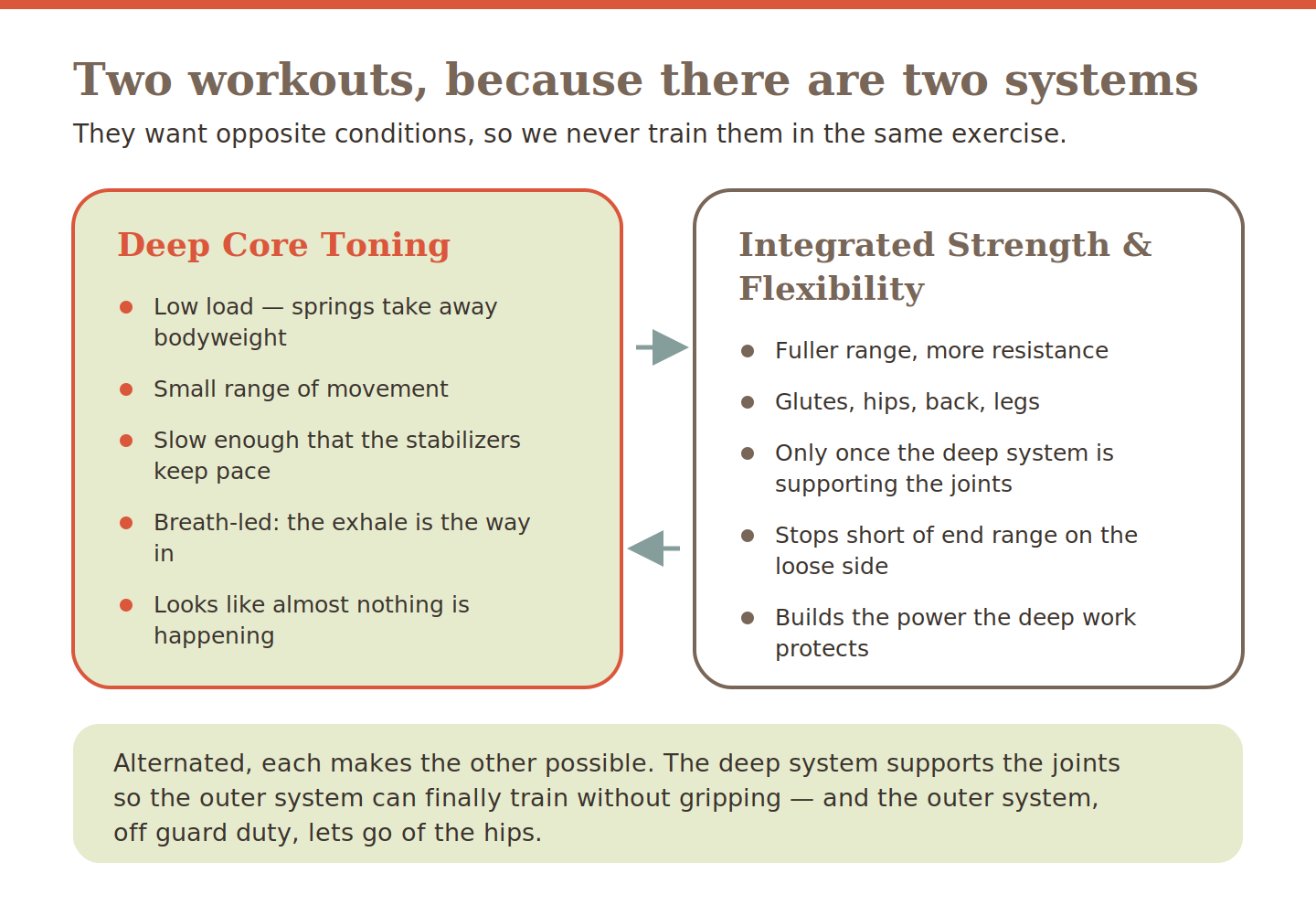
Deep Core Toning works the reflexive system. Low load — the reformer springs take away enough bodyweight that the small muscles can start firing again. Small range. Slow enough that the stabilizers can keep pace with the movement. Breath-led, because the exhale and the pelvic floor and the transversus abdominis are wired together, and the breath is the reliable way in. To an observer, almost nothing is happening. Maren found the first few sessions maddening for exactly that reason.
Integrated Strength and Flexibility works the outer system — glutes, hips, back, legs — through fuller ranges with more resistance, but only once the deep system has come back online to support the joints. For a hypermobile client we also stop short of end range on the loose side, because loading an already-lengthened ligament teaches it nothing useful.
Run alone, either program is incomplete. Deep work without strength leaves you stable but underpowered. Strength without deep work is what Maren had been doing for a decade. Alternated week to week, each makes the other possible: the deep system supports the joints so the outer system can finally train without gripping, and the outer system, no longer on guard duty, lets go of the hips.
What it looked like in practice
Weeks one and two: breath, feet, and tiny movements on the reformer. Maren's homework was a long pursed-lip exhale with a light lift at the end — not a Kegel, a lift, then a complete release. The release was the hard part. Her pelvic floor did not know how to stop.
Month two: her hips were less sore, and she noticed she could sit cross-legged for a few minutes. Her SI joint shifted once that month instead of three times. Month four, finishing her first full sixteen-week cycle: the shifts were rare, her pelvic floor therapist measured a lower resting tone, and the gluteal strength work that used to flare her now didn't.
I want to say plainly what did not change. Maren still has hEDS. Her ligaments are as extensible as they were. She still sees her rheumatologist and her pelvic floor therapist, and she should. What changed is which muscles arrive first when she stands up, and that is a skill the nervous system keeps. Progress was measured in months, and it will keep going for years.
If you have pelvic pain, leaking, or an SI joint that shifts, see a pelvic health physical therapist and, if you haven't, a physician who knows connective tissue disorders. Movement does not treat hEDS. It can change how a hypermobile body organizes itself, and that turns out to be a great deal.
What we've measured
VASIE® has been taught since 2000 to more than 10,000 clients, and hypermobile clients are a large share of them. Across hundreds of two-week breath-based intensives we measured height and abdominal circumference before and after,* with video movement analysis. Pelvic tilt moved toward neutral in most participants. Physical therapists and physicians in our referral network have refined these exercises with us over the years; the low-load progression for loose joints came largely out of that feedback.
* Day one and day six of class, standing, after a normal exhale: low abdomen (hip bone to hip bone), waist, and lower rib cage. In-house measurements, not a controlled trial.
Two ways to start, neither of them fast
Studio One VASIE® Pilates
Pilates 101 teaches the breath and the low-load basics first. Tell us you're hypermobile and we'll modify from day one.
Book Pilates 101VASIE® Pilates Online
The free Flat Abs Fast mini course starts with a two-minute self-assessment. If your abdominals brace instead of answering the breath, you'll see it — and the 27-minute session that follows is low-load by design.
Start the free mini courseAna Kokaurova is a Certified Advanced Rolfer®, a Stott-certified Pilates instructor, and a VASIE® Pilates Instructor Trainer. She has been teaching since 2000 and co-developed the VASIE® method — Van Alstine Structural Integration Exercise — which combines the principles of Rolfing® Structural Integration with the exercise system developed by Joseph Pilates.
References
- Snijders CJ, Vleeming A, Stoeckart R. Transfer of lumbosacral load to iliac bones and legs. Part 1: Biomechanics of self-bracing of the sacroiliac joints and its significance for treatment and exercise. Clinical Biomechanics. 1993;8(6):285–294.
- Fatoye F, Palmer S, Macmillan F, Rowe P, van der Linden M. Proprioception and muscle torque deficits in children with hypermobility syndrome. Rheumatology. 2009;48(2):152–157.
- Gilliam E, Hoffman JD, Yeh G. Urogenital and pelvic complications in the Ehlers-Danlos syndromes and associated hypermobility spectrum disorders: a scoping review. Clinical Genetics. 2020;97(1):168–178.
- O'Sullivan PB, Beales DJ. Diagnosis and classification of pelvic girdle pain disorders — Part 1: a mechanism based approach within a biopsychosocial framework. Manual Therapy. 2007;12(2):86–97.
Stay connected with news and updates!
Join our mailing list to receive the latest news and updates from our team.
Don't worry, your information will not be shared.
We hate SPAM. We will never sell your information, for any reason.