The Astonishing Reason Your Back Hurts Where It Moves the MOST
Oct 06, 2026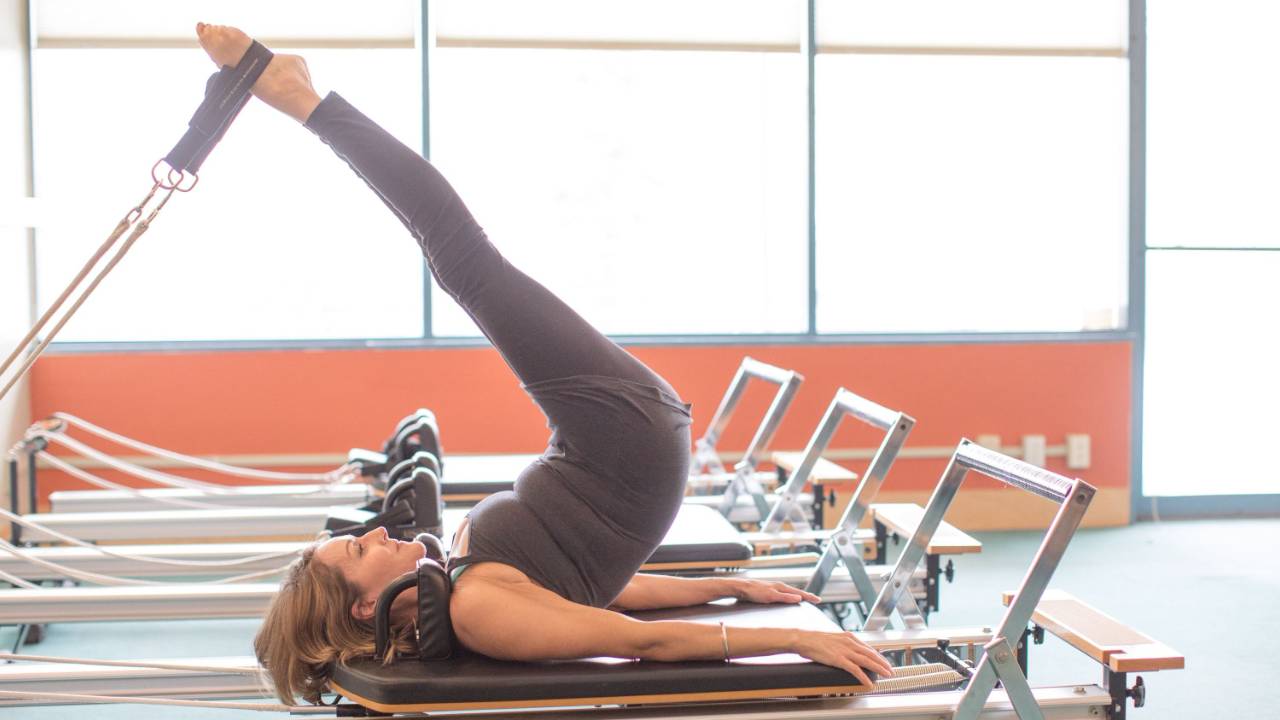
Spine Month
Most spines have several segments that move too much and are frozen everywhere else. Teaching the whole spine to bend sequentially and evenly is a powerful way to distribute the stress through the whole spine instead of wearing out just a couple of spots. We are deep diving into spinal articulation this month at Studio One.
By Ana Kokaurova, Certified Advanced Rolfer®, Stott-certified Pilates instructor, VASIE® Instructor Trainer · October 19, 2026 · 9 min read
 The short version
"My joints are hypermobile." "My spine feels stiff in the morning." I hear both sentences in Pilates 101 all the time, and very often from the SAME person. That is not a contradiction. It is one pattern. Your spine has 24 movable vertebrae, and when a few of them do all the bending, two things happen at once: those segments get loose and sore from overwork, and the muscles around them grip to protect them, which makes everything else feel stiff. Loose in two spots, frozen everywhere else. So why do most programs tell you to stretch the stiff parts and strengthen the loose ones? Because it's easy to teach, and it feels like something is happening. If you are here reading this, you've probably done both and you still hurt in the same spot. Let's dig in.
The skill that changes this is called sequential articulation: moving the spine one vertebra at a time so every segment takes its share of the bend. Pilates was built around it. It is slow, it is precise, and it takes months, and it is the single most useful thing a hypermobile spine can learn.
The deep dive
What I see when twelve people roll up
Every Pilates 101 class, at some point, I ask the room to lie down, reach the arms to the ceiling, and roll up to sitting one vertebra at a time. Then I watch. Not the arms. Not the legs. The SPINE.
Here is what happens almost every time. Out of twelve people, maybe one rolls up like a wave, each vertebra peeling off the mat in turn. The other eleven do some version of the same thing: the upper back stays flat as a board, the low back stays flat, and somewhere in the middle, usually right around the waist, the whole body FOLDS at one spot. Pop. Up they come. Some of them can't get up at all without a jerk or a kick of the legs. And the ones who tell me they are hypermobile? They are often the ones who fold the hardest, at the loosest spot, and then tell me afterward how stiff they feel.
I love this moment, because nobody has ever shown them this before. A roll up is not a strength test. It is an X-ray you can do on your living room floor. It shows you, in about four seconds, exactly which parts of your spine move and which parts have quietly stopped.
Watch Video and Follow Along: the Roll Up and Posture Prep, taught the VASIE® way
A spine is not one joint. It is twenty-four.
Your spine has 24 movable vertebrae stacked on your sacrum, with a disc between each pair. Every one of those pairs is a joint, and every one of them is built to bend a little. A LITTLE. When you curl forward, that curl is supposed to be shared out: a few degrees here, a few degrees there, all the way up. Spread across 24 joints, nobody is working very hard.
Now imagine twenty of those joints stop bending. Maybe from sitting, maybe from an old injury, maybe from years of bracing your abs. The curl still has to happen somewhere, so it piles up in the two or three joints that are still willing. Those joints now bend ten times more than they were designed to, on every bend you make, all day long. Physical therapist Shirley Sahrmann calls this relative flexibility: the body always moves first at the place that moves most easily, and the place that moves most easily becomes the place that moves too much.1 Movement researchers Mark Comerford and Sarah Mottram gave the result a blunt name, uncontrolled movement, and they showed where it ends up: pain and tissue wear happen at the segment doing the extra work, NOT at the stiff segments that caused it.2
This is the part that surprises everyone. The stiff part of your back is not the part that hurts. The stiff parts are the problem; the loose part is the victim. And when researchers put people with low back pain inside an MRI and watched their spines bend, that is exactly what showed up: motion bunched into one or two lumbar segments instead of shared across all five.3
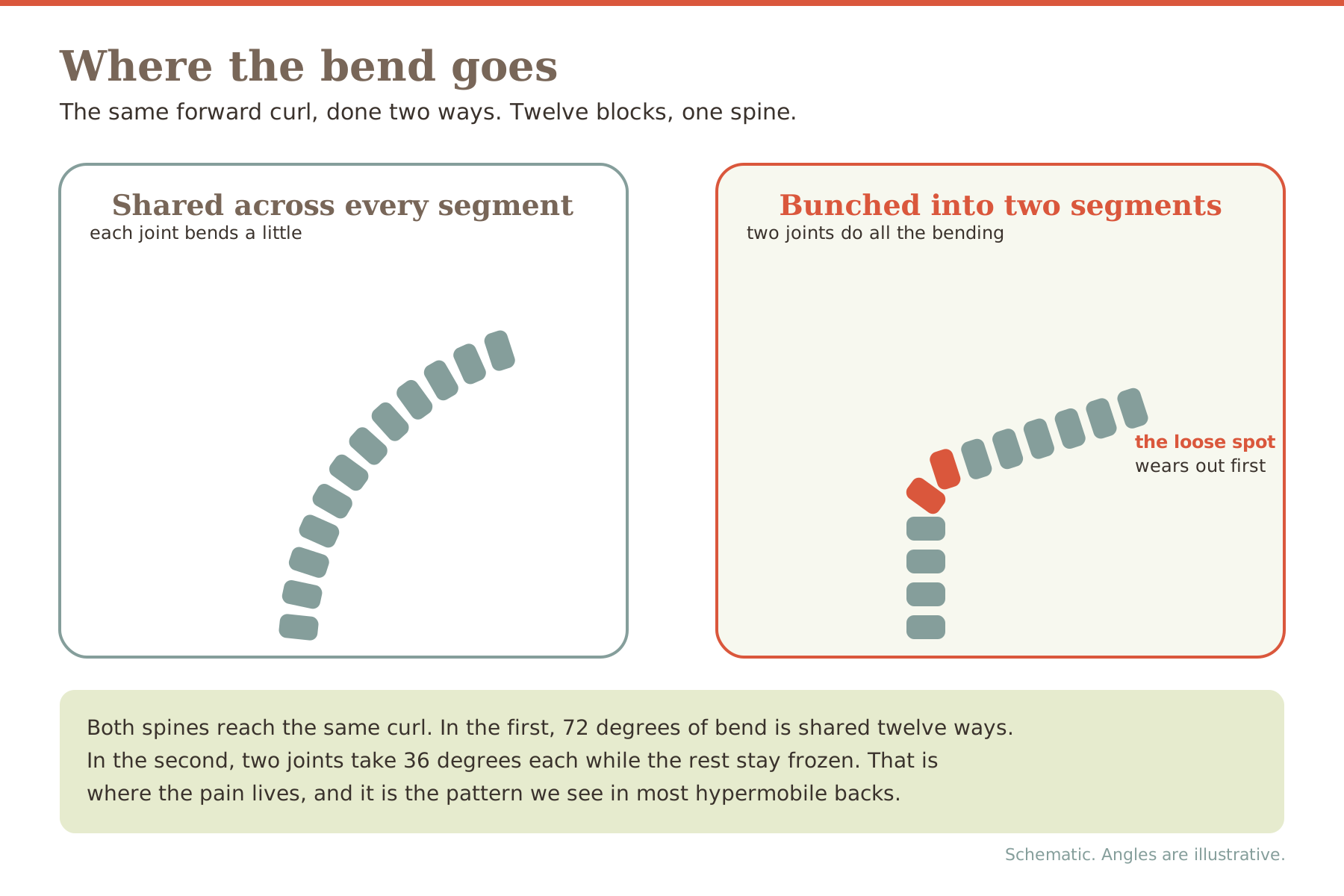 Both spines reach the same curl. One shares it twelve ways. The other asks two joints to do everything.
Why you can be hypermobile AND stiff
If your joints are hypermobile, this pattern is turned up to eleven. Your ligaments give later than most people's, so the loose segments in your spine move even MORE before anything stops them. Your nervous system knows this. It does not like it. So it does the only thing it can do without a trained deep core: it grips the big muscles around the loose segment to hold it still. Those gripping muscles are what you feel in the morning. That is the stiffness. It isn't a short muscle and it isn't a stuck joint. It is a bodyguard, and it is exhausted (the manual calls this fast-twitch muscle doing a slow-twitch job, and it is why the tension never fully goes away).
So you go to class and stretch the stiff parts. The bodyguard lets go for an hour, the loose segment is unprotected again, and by the next morning the grip is back, because it HAS to be. Or you go to the gym and brace your core to "stabilize," and now you have a spine that doesn't bend anywhere, which fixes nothing and makes the roll up impossible. I have watched hypermobile clients do both for years and get nowhere, and it is not their fault. Nobody told them the loose and the stiff were the same problem.
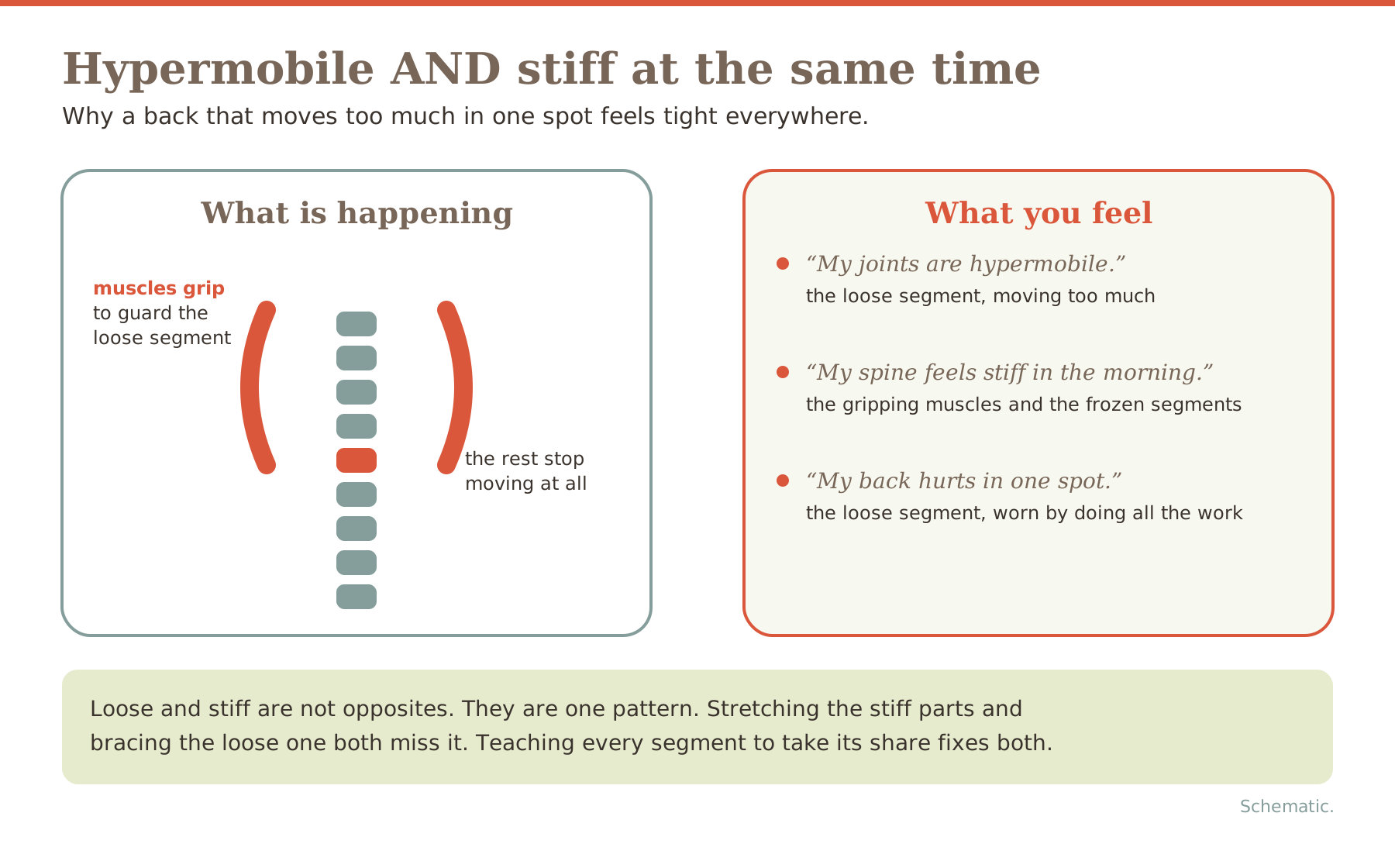 Loose and stiff are not opposites. They are one pattern.
"A man is as young as his spinal column"
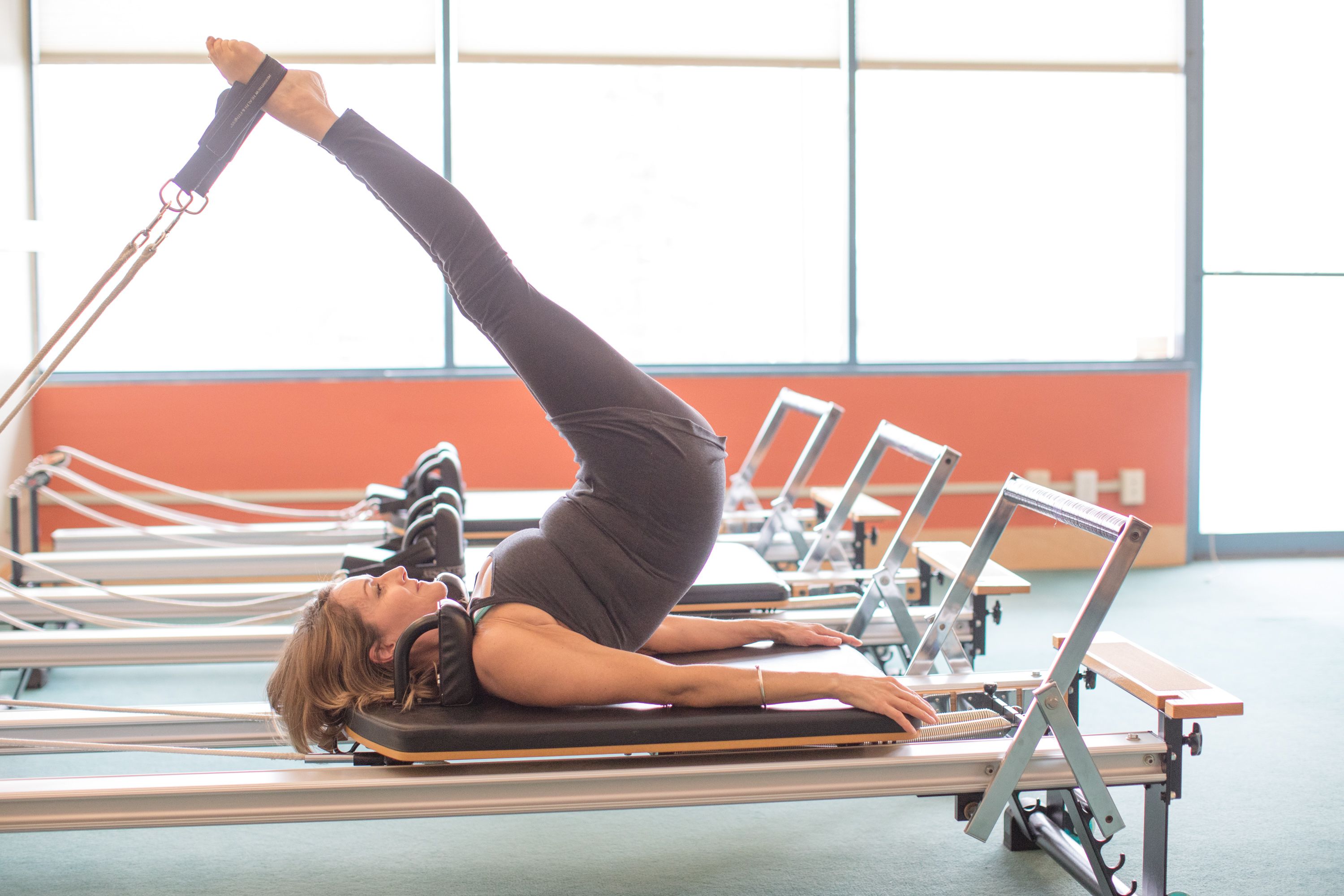
Joseph Pilates understood this a hundred years ago, before anyone had an MRI. His most famous line is the one on every studio wall: "If your spine is inflexibly stiff at 30, you are old; if it is completely flexible at 60, you are young." He also put it more bluntly: "A man is as young as his spinal column."4 People read those quotes as being about flexibility. They aren't, really. Pilates built an entire system around moving the spine one vertebra at a time, in order, on the breath. The roll up, the roll over, the spine stretch, the shoulder bridge: every one of them is a sequencing exercise. He wasn't asking for a bendier back. He was asking for a back where EVERY segment still does its job.
In VASIE® we call this sequential articulation, and our instructor manual defines it as "the act of segmenting, or putting space between the vertebrae." It goes one step beyond the skill we worked on last week, moving a leg without moving the pelvis, which we call neuromuscular differentiation. Articulation is differentiation INSIDE a structure: each vertebra learning to move on its own, in turn, without its neighbors taking over. The manual also says the quiet part out loud: this is hard. It depends entirely on proprioception, your sense of where you are in space, and "most of the time our proprioception is off." The spot that feels stuck and the spot that moves too much are usually invisible to you until someone, or a slow enough exercise, shows you.
That is why it matters that the research on Pilates for hypermobility keeps finding the same thing. In a 2026 trial of 420 people with hypermobility, an online Pilates program built on slow, controlled movement improved pain and function, and, this is the part I care about, it significantly improved body awareness. The gains were still there six months later.5 You cannot share the bend across 24 joints until you can feel which ones are bending. Pilates teaches the feeling.
Two tests to read your own spine
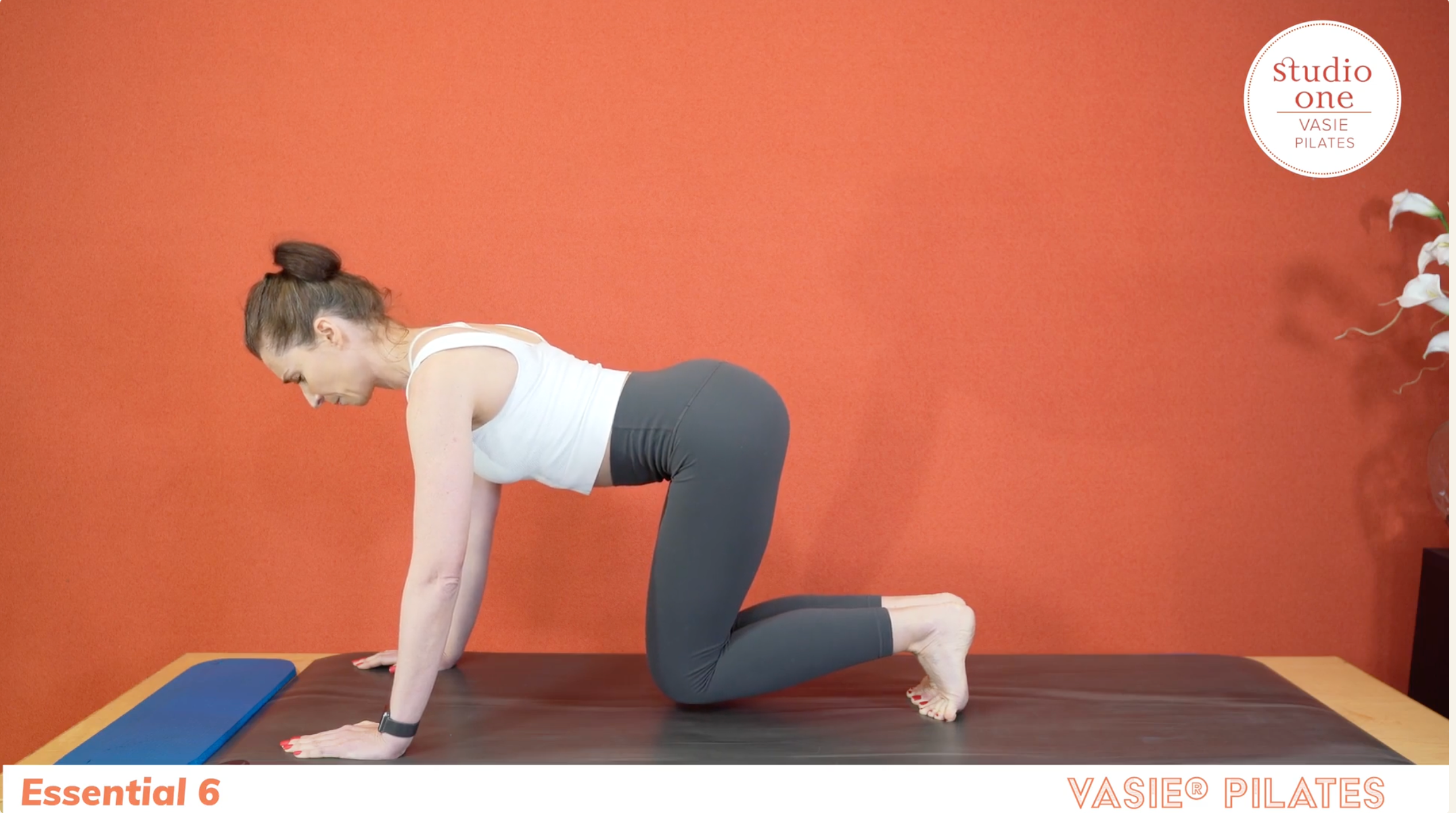
These are two of the six exercises we teach in Pilates 101, and they are in the free Essential 6 video. Do them slowly, and pay attention to the SHAPE of the movement, not whether you "made it."
1. Posture Prep. Lie on your back, knees bent, feet flat, no pillow under the head. Start in neutral. Exhale and roll the pelvis up one vertebra at a time, on as many exhales as you need, until you have a straight line from your ribs to your knees. You should feel your glutes and the backs of your legs working. Exhale to roll back down, again one vertebra at a time. Now the reading: did your low back peel up in pieces, or did it come up as one flat plank? Did your lower ribs pop toward the ceiling on the way up? That rib flare is a sign the glutes and hamstrings aren't holding enough tone, so the low back and hip flexors are driving the movement instead. Keep the ribs heavy on the mat. The ribs move LAST, not first.
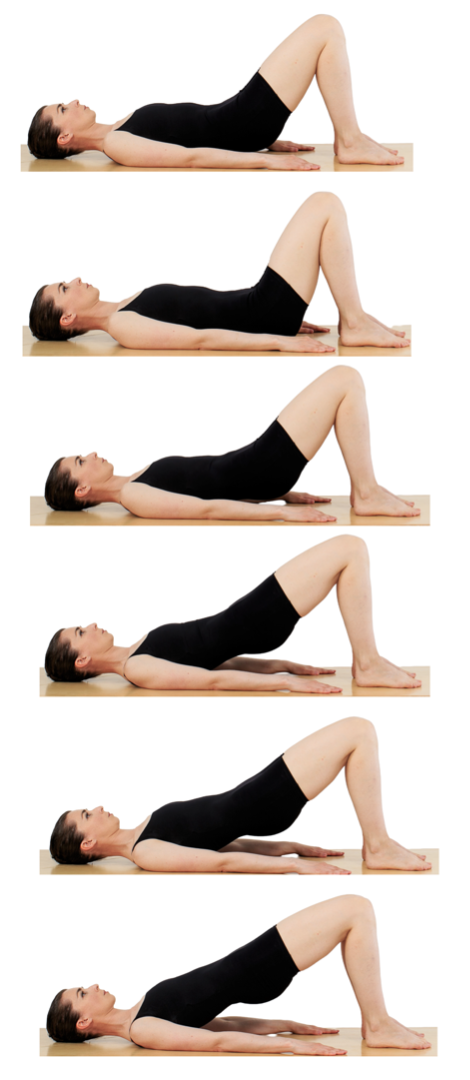
Posture Prep. The pelvis peels up and down one segment at a time. The ribs stay heavy.
2. The Roll Up. Lie flat, legs long, arms toward the ceiling. Exhale, nod the chin, and peel the spine off the mat one vertebra at a time until you are sitting over your legs, then reverse it on the way down. Now the reading. If you came up like a smooth C, congratulations, that is rare. If you came up flat, flat, flat, and then FOLDED at one spot, that fold is your loose segment. The flat parts are your frozen ones. If you couldn't get up at all without a jerk, that's useful too: it means the frozen segments outnumber the free ones, and the bend has nowhere to go. That is not a failure. That is the information.
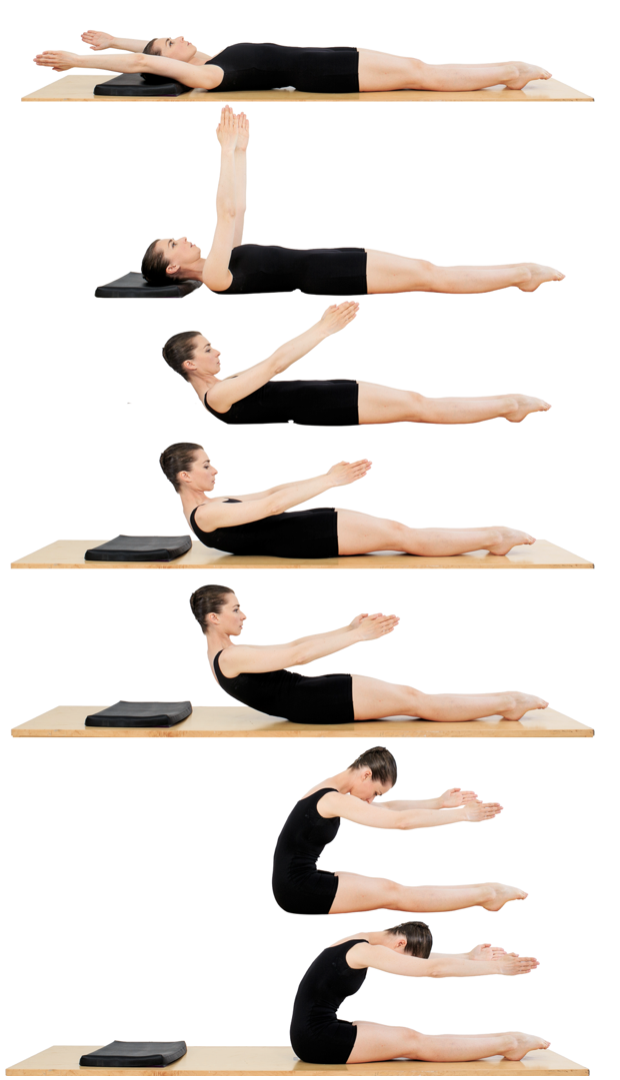 The Roll Up. A smooth C, every vertebra in turn, head mat removed as the spine comes up.
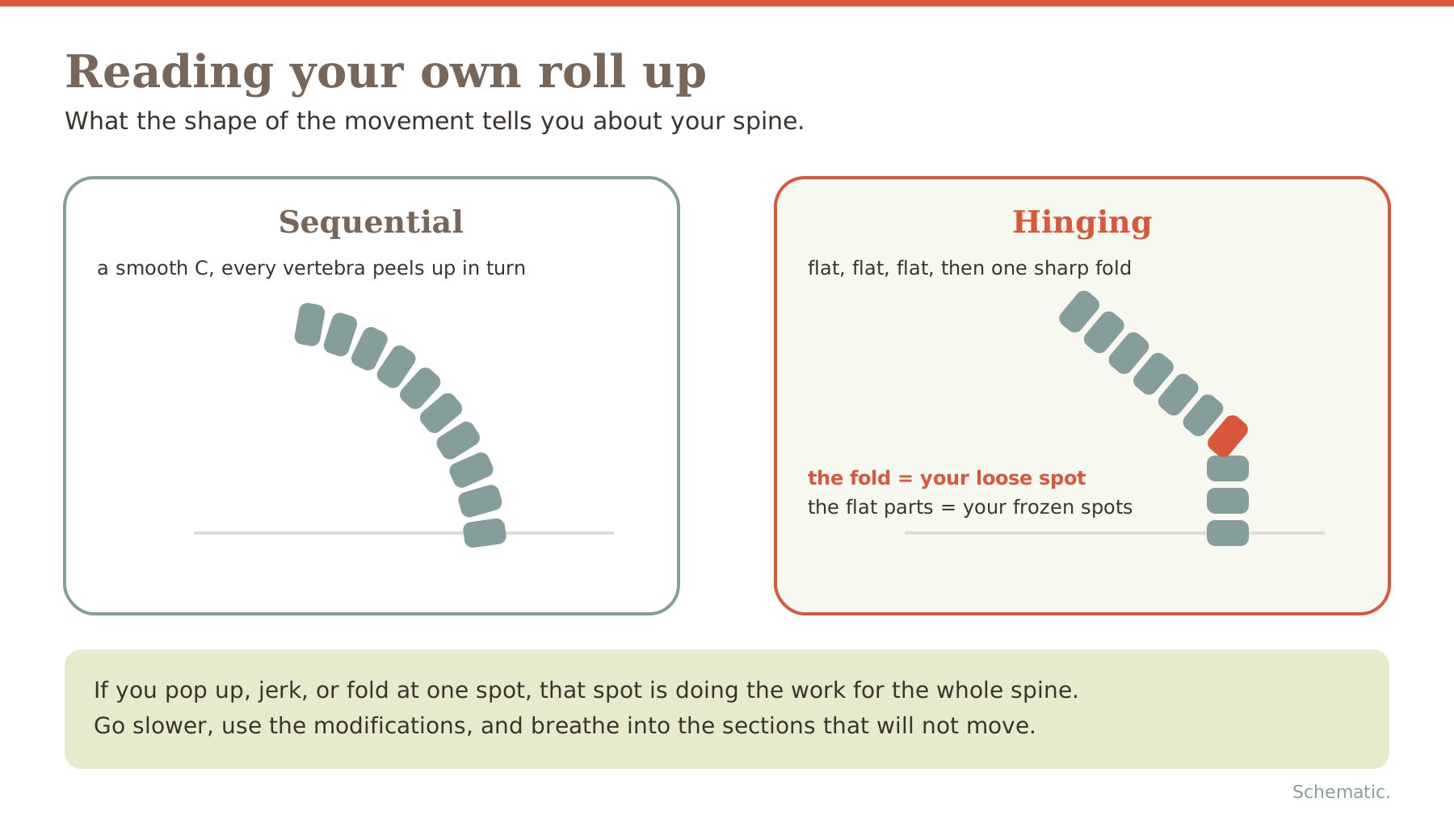 The fold is your loose spot. The flat parts are your frozen spots.
If the full roll up isn't there yet, you are in good company, and we have four ways to meet you where you are: knees bent, a small ball under the knees, a band around the feet to pull against, or light weights in the hands to give the arms some momentum. None of these are cheating. They are how you keep the SHAPE honest while the spine learns.
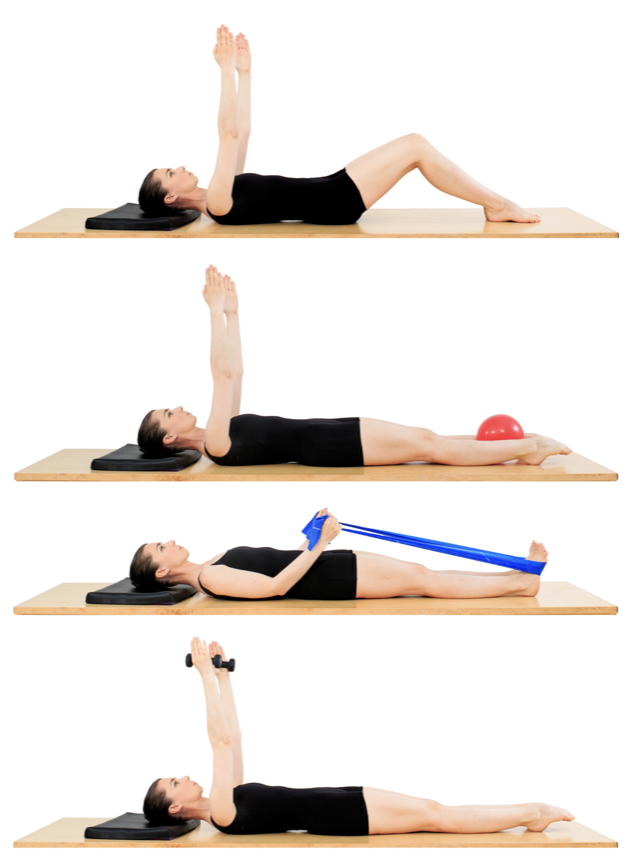
Four ways to keep the shape honest while the spine learns.
What to do in class this month
The third of the six VASIE® differences is Structural Integration: we don't treat the sore segment. We balance the whole structure so the load gets shared, and the sore segment stops being asked to do everything. For your spine, that means this month in class we are going to do the slowest, most boring-looking, most IMPORTANT work in the whole system. Here is how to get the most out of it.
- One exhale, one vertebra. Every articulation exercise in VASIE® moves on the exhale only. Use as many breaths as you need. Three slow, honest segments beat one fast fold every time.
- Linger at the stuck spots. Straight from our manual: when you feel a section that resists or feels stuck, that is where you want to be. Stop there. Breathe into it. Wait for it. That spot is a frozen segment learning it is allowed to move.
- Make the loose spot smaller, not bigger. If you know where you fold, your job is to NOT fold there. Ask the segments above and below to take some of the bend. Hypermobile clients: this is your whole month. Less range at the loose spot, more range everywhere else.
- Low abs first, every time. Before any part of the spine moves, the gentle hookup: toes pressing, pursed-lip exhale, a small lift of the pelvic floor. The deep core has to be holding the pelvis before the spine can afford to let go segment by segment. This is why we never say "engage your core." We give you the doors in.
- Use the modifications without apology. Bent knees, the ball, the band, the weights. Your instructor will hand you one. Take it. The shape of the movement matters more than finishing it.
- Ask yourself two questions. We train our instructors to ask them constantly, and you can too: "Are my ribs in the right place?" and "Am I in neutral?" If the ribs flare or the pelvis tucks, the sequence has been handed to the big muscles again.
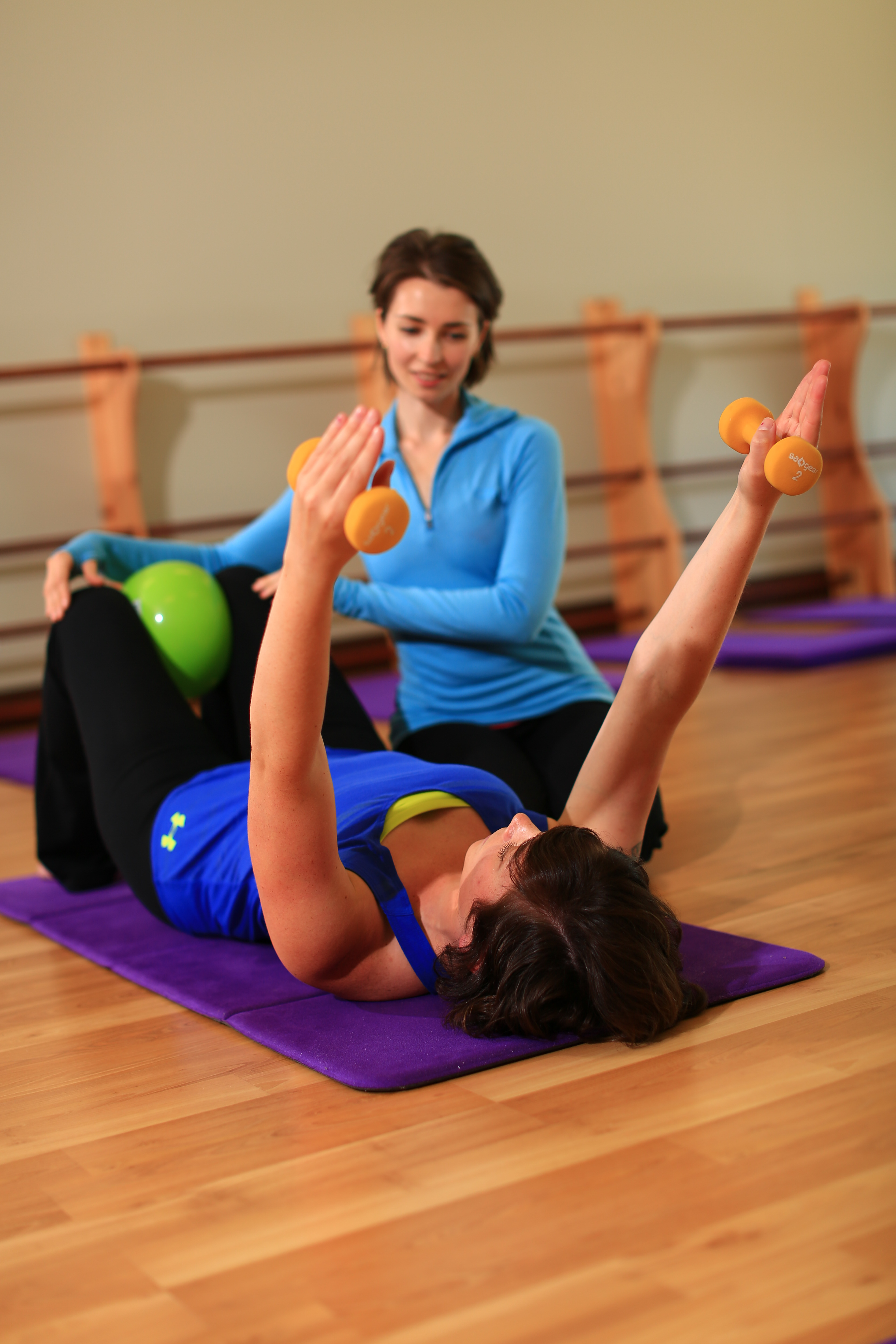 No music, no mirrors. Your teacher walks the room and puts her hands on the segments you can't feel yet.
What to expect
In the first few classes most people simply discover where they fold, and that alone changes how they move during the day. Within a few weeks the morning stiffness usually eases, because the bodyguard muscles finally have a reason to stand down. A spine that shares the bend evenly is a months-long project, not a weeks-long one, and we run it in sixteen-week cycles for that reason. The good news is that it holds. Once a segment remembers how to move, it tends to keep moving, like riding a bike.
One important note. The roll up and its cousins load the spine in flexion. If you have a diagnosed disc herniation, osteoporosis, or pain that travels down a leg, numbness, tingling, or any change in bladder or bowel control, talk to your physician or physical therapist before doing loaded flexion, and tell your instructor when you book. We have a full extension-based track for exactly this situation, and nothing in this post replaces the care of a physical therapist. Several of the ones our clients see have helped shape these exercises.
What we've measured
Since 2000, more than 10,000 clients have trained in VASIE®. Across hundreds of two-week breath-based intensives we measured height and abdominal circumference before and after,* and analyzed posture on video. The average is over 3 inches off the low abdomen and three quarters of an inch of height. Height is what you get when a spine stops bunching its curves into a few segments and spreads them out again, which is exactly what sequential articulation trains. Nobody in those classes was told to stretch, and nobody was told to brace.
* Day one and day six of class, standing, after a normal exhale: low abdomen (hip bone to hip bone), waist, and lower rib cage. In-house measurements, not a controlled trial.
Find out where your spine bends, and where it doesn't
Studio One VASIE® Pilates
Pilates 101 is free, 90 minutes, and small enough that your teacher's hands are on your back while you roll up. You'll find your fold and your frozen spots in the first hour, and leave knowing WHY your back does what it does. Tell us your joints are hypermobile when you book and we modify from the first exercise. 20 to 30% off a membership if you want to keep going.
Book your free Pilates 101VASIE® Pilates Online
The 6 Essential Exercises is a free 12-minute follow-along video plus a PDF. The roll up and the posture prep from this post are in it, taught slowly, on the breath, with the modifications. Do it twice and you'll know exactly where your spine bends.
Get the 6 Essential Exercises freeAna Kokaurova is a Certified Advanced Rolfer®, a Stott-certified Pilates instructor, and a VASIE® Pilates Instructor Trainer. She has been teaching since 2000 and co-developed the VASIE® method — Van Alstine Structural Integration Exercise — which combines the principles of Rolfing® Structural Integration with the exercise system developed by Joseph Pilates.
References
- Sahrmann SA. Diagnosis and Treatment of Movement Impairment Syndromes. Mosby; 2002.
- Comerford MJ, Mottram SL. Movement and stability dysfunction: contemporary developments. Manual Therapy. 2001;6(1):15–26.
- Kulig K, Powers CM, Landel RF, et al. Segmental lumbar mobility in individuals with low back pain: in vivo assessment during manual and self-imposed motion using dynamic MRI. BMC Musculoskeletal Disorders. 2007;8:8.
- Pilates JH, Miller WJ. Return to Life Through Contrology. 1945.
- Russek LN, et al. An online Pilates program for people with hypermobility: a pragmatic clinical trial. Journal of Multidisciplinary Healthcare. 2026;19.
Stay connected with news and updates!
Join our mailing list to receive the latest news and updates from our team.
Don't worry, your information will not be shared.
We hate SPAM. We will never sell your information, for any reason.