
Why "Engage Your Core" Fails — and the Hack That Works
Sep 12, 2026
Case study · Pelvis & Core month
Your deep core fires a fraction of a second before you move. Bracing can't keep that timing — but four muscles you can control will do it for you.
By Ana Kokaurova, Certified Advanced Rolfer®, Stott-certified Pilates instructor, VASIE® Instructor Trainer · September 14, 2026 · 8 min read
The short version
The muscles that stabilize your spine — the transversus abdominis, multifidus, diaphragm, and pelvic floor — are reflexive. In a well-organized body they switch on about a twentieth of a second before the arm or leg moves. When you "engage your core" on purpose, you recruit the big surface muscles instead, lock the ribs, and hold your breath. You feel tighter and get nothing that lasts.
The way in is indirect and reflexive: the exhale with pursed lips, activate and use the respiratory diaphragm, the pelvic floor, and the feet. Work those, and the deep core (Transversus Absominus) muscles will activate spontaneously . That is the first of the six things that make VASIE® different, and one of the focuses of this month is reflexive core activation.
The deep dive
"I have a core. I do planks."
Claire came to my Pilates 101 class and her abs were braced. In her mid-forties, she is hypermobile in the way many of my clients are — elbows and knees that go a little past straight, a spine that folds easily, a history of ankle sprains — and she had been told by a trainer, a physical therapist, and a yoga teacher to engage her core. So she did. All day. At her desk, in the car, standing at the sink. She could hold a plank for two minutes. Her lower back still ached by three in the afternoon, she was exhausted by evening, and her waist had not changed in four years of trying.
Claire is like dozen clients I have taught over twenty-six years. The sentence she said in that first class I have heard almost word for word many times: "I don't understand. I have a core. I do planks and sit ups, I can see my six pack!" ...so why were her low abs still distending vs her upper abs? and why did she feel still have pain and tension?
She was right. She did have a core. She had built a very strong set of muscles that shorten the front of the body and compress the spine when overworked, and taught them to do a job they cannot do. We had to dig deeper.
Why the advice she was given made sense
I want to be fair to everyone who told Claire to engage her core, because the instinct is correct. Her spine and pelvis were under-supported. In a hypermobile body the ligaments give a little more and a little sooner, so the passive part of stability — the part you get for free from joint shape and connective tissue — is doing less. Something has to make up the difference. Bracing is a rational answer to a real problem.
It is just the wrong tool, and the reason is anatomical rather than a matter of effort.
Two systems, one of which you can't talk to
Your trunk has two muscle systems. The first is the one you know: the rectus abdominis and the obliques on the front and sides, the erector spinae along the back, the big hip muscles below. These are what I call the gym muscles. You can feel them, you can flex them on command, and they produce movement and power. They are also, when overworked, exactly what creates the shortness and tightness people associate with getting older.
The second system is deeper. The transversus abdominis — the corset muscle that wraps the waist from the spine forward — and the multifidus, a chain of short muscles that run segment to segment along the back of the spine, work together with the respiratory diaphragm above and the pelvic floor below. Together they pressurize and stiffen the trunk like a well-packed cylinder. They are what actually holds a joint neutral.
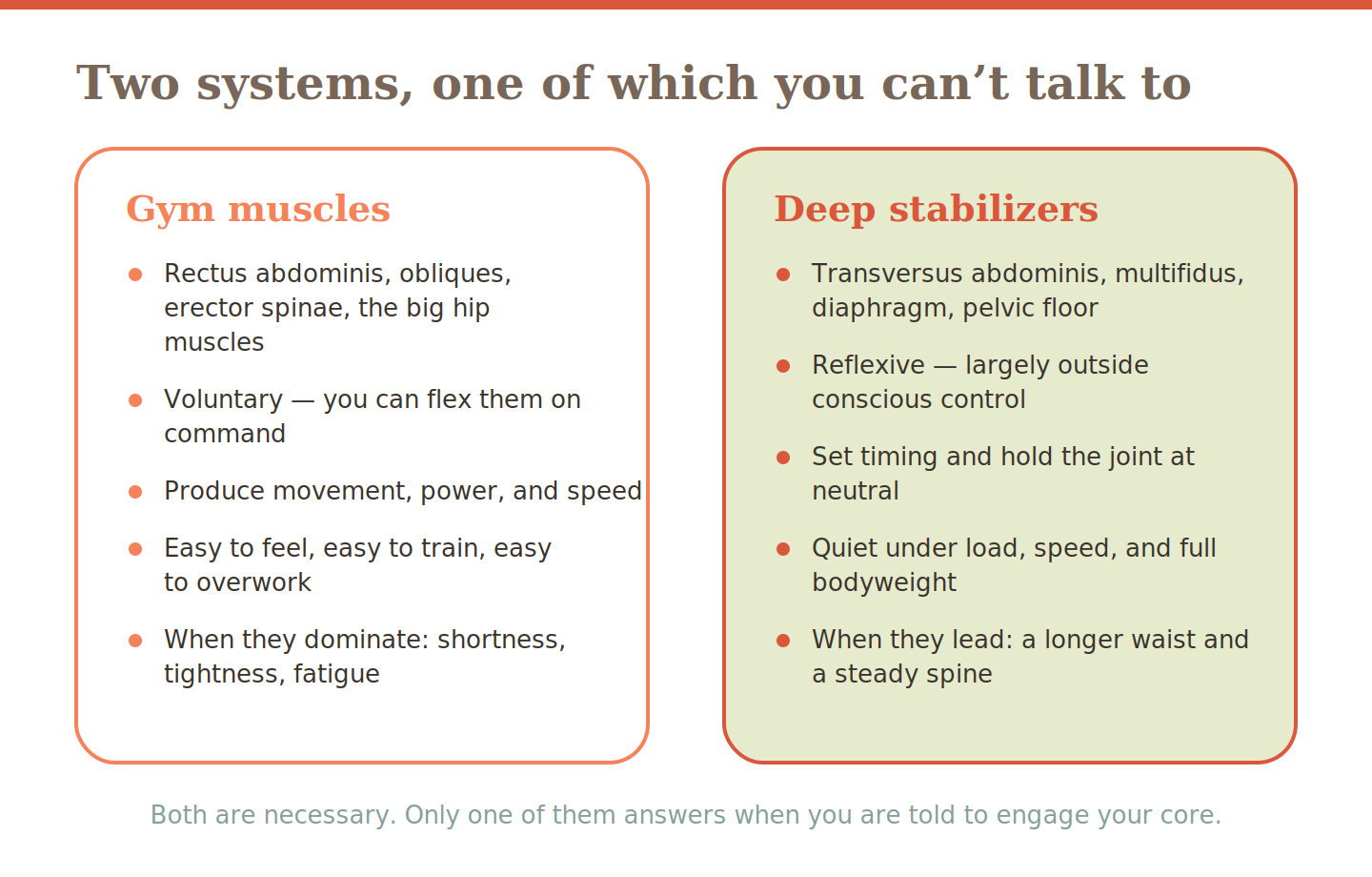
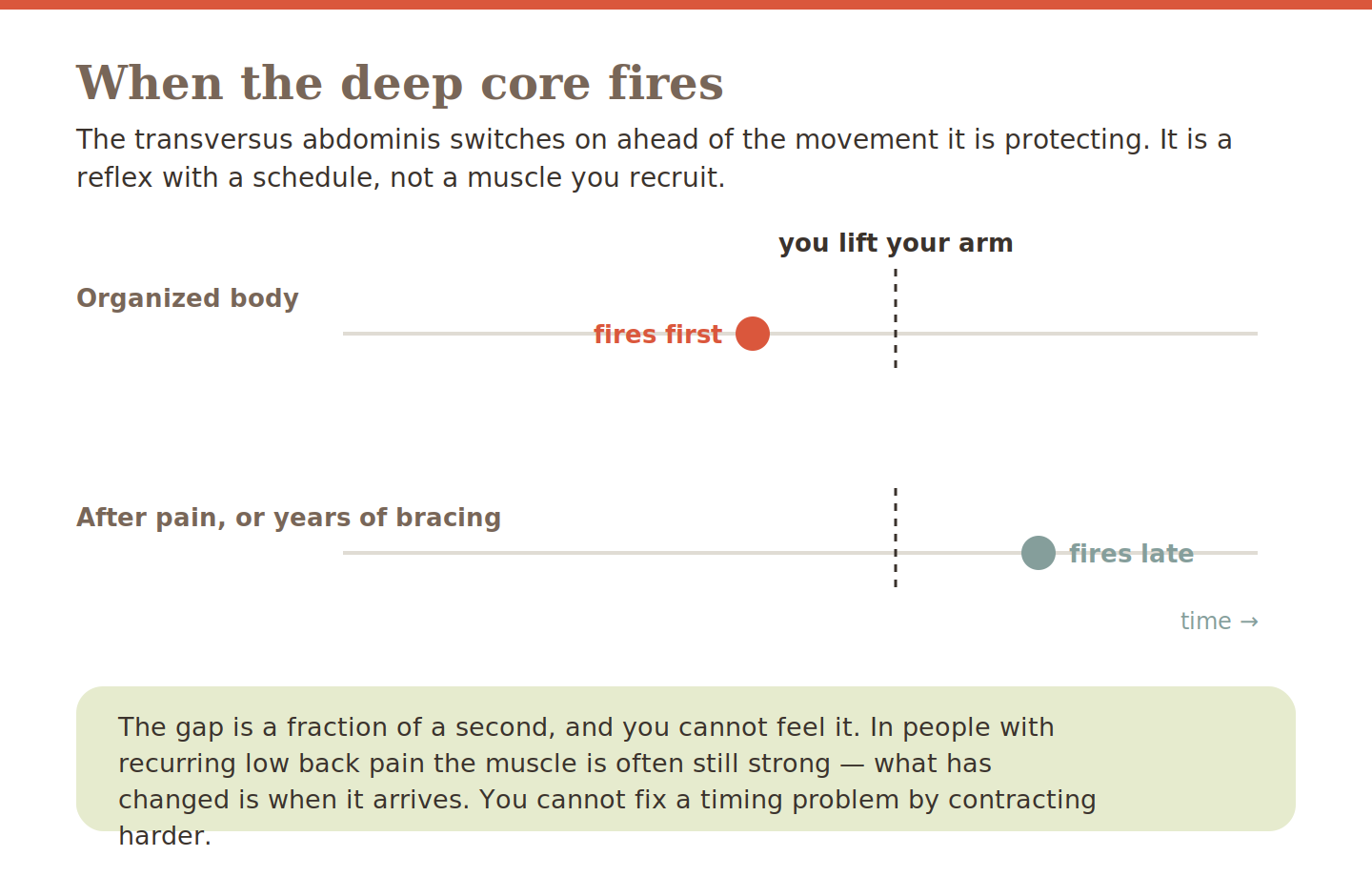
And they are largely involuntary. Paul Hodges and Carolyn Richardson showed in the 1990s that in people without back pain, the transversus abdominis contracts before a limb even starts to move — a feedforward reflex, timed by the nervous system in anticipation of load rather than in response to it.1 In people with recurring low back pain, the same muscle fires late.2 The strength is often still there. The timing has gone.
You cannot fix a timing problem by contracting harder, any more than you can fix a late alarm clock by shouting at it.
What "engage your core" actually does
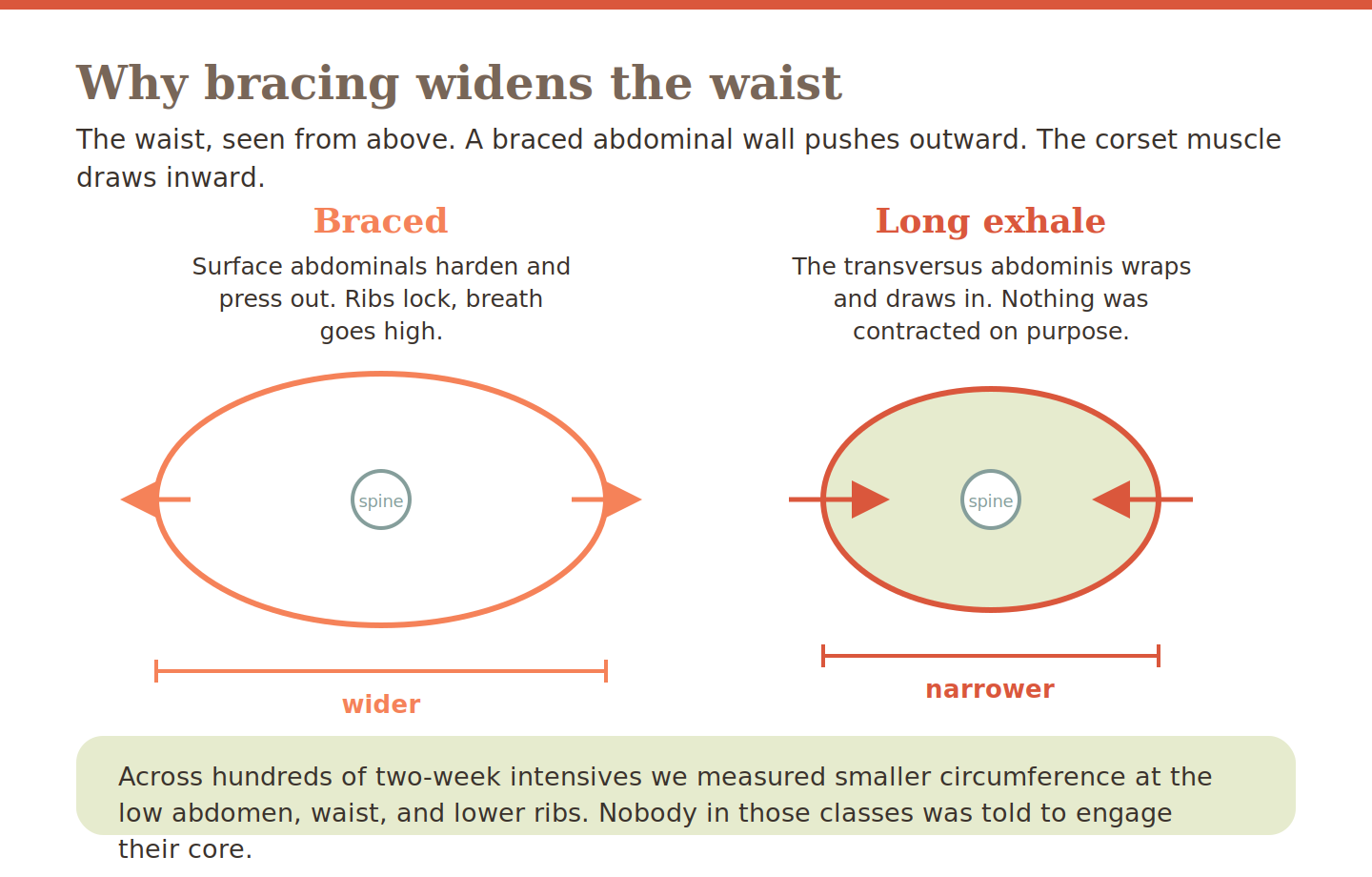
When Claire braced, here is what I watched happen in class. Her ribs dropped and locked. Her breath went shallow and high in the chest. Her rectus abdominis and obliques hardened into a shell — visible, tense, and completely voluntary. Her waist got wider, not narrower, because a braced abdominal wall pushes outward. And somewhere under all of that, the deep system had no reason to come online at all. Why would it? The job had been taken.
Do that for an hour, and you have a tiring workout. Do it for four years, and you have trained the nervous system to lead with the wrong muscles. The reflexive system gets quieter with each week it isn't asked to work. It does not disappear — and that is the hopeful part — but it does go quiet, and a hypermobile body pays for that faster than most, because it has less passive support to fall back on.
This is why we don't cue "engage your core" at Studio One, and why I train instructors specifically not to. It is the first of the six differences in the VASIE® method: the automation of core and posture. The deep core is not something you do. It is something you create the conditions for, and then get out of the way of.
The Hack: The four muscles you can control
Between the gym muscles and the reflexive muscles there is a small group I think of as semi-voluntary. You can command them, but they are wired into the same reflex loops as the deep stabilizers. They are the way in.
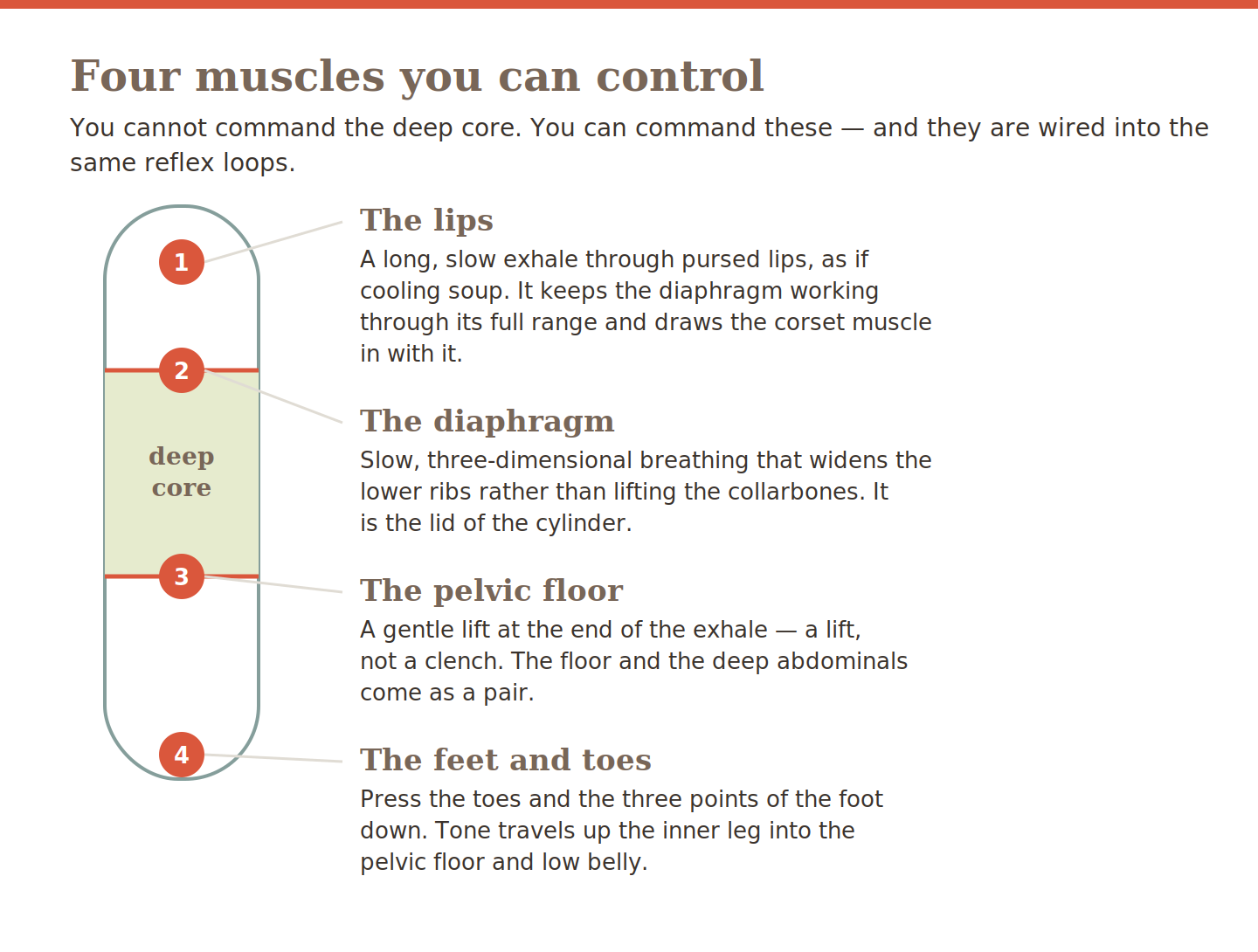
Pursed lips. A long, slow exhale through pursed lips — as if cooling soup — lengthens the out-breath, keeps the diaphragm working through its full range, and recruits the transversus abdominis as part of forced expiration. The diaphragm has both a breathing job and a postural job, and it does them at the same time.3 When Claire exhaled this way for the first time, her waist narrowed visibly and her ribs softened. Nobody told her abdominals to do anything. They answered the breath.
The pelvic floor. A gentle lift — not a clench — at the end of an exhale. The pelvic floor and the deep abdominals co-activate; ask one, and the other tends to come with it.4 Gentle matters. A hypermobile pelvic floor is often already overworking, and I'll come back to that next week.
The feet and toes. If you followed our foot month in August, this is where it pays off. Pressing the toes and the three points of the foot into the floor or the reformer footbar sends a chain of tone up the inner leg, through the adductors, and into the pelvic floor and lower abdomen. I can produce a longer, narrower waist in a client with a foot cue faster than with any abdominal cue I know.
The diaphragm itself, through slow, three-dimensional breathing that moves the lower ribs rather than lifting the collarbones. Slowness is the point. We call it BREATHlinking: moving at the speed of your stabilizing muscles, slowly enough that they can keep up.
Why the reformer, and why slow
Deep stabilizers that have gone dormant do not wake up under a heavy load. They shut down further. Speed, full bodyweight, and effort all favor the gym muscles, which is why Claire's planks made her stronger without making her more stable. The reformer reduces the load enough that the small muscles can begin to fire again, and slowness gives you the time to activate the right ones. In a VASIE® Pilates class the first few weeks of core month look, to an outsider, like very little is happening. Inside the body, a great deal is.
What changed for Claire, and how long it took
In week two she noticed she was breathing lower at her desk without deciding to. By the end of the first month she had stopped bracing — not through discipline, but because the reflexive system had started arriving on time and the bracing felt unnecessary. Her three-o'clock back ache faded over about eight weeks. Her waist measured smaller at the end of a two-week intensive than at the start, which is what we see in most participants (the numbers are below).
What I want to be honest about: this is months, not days, and she is still hypermobile. Nothing here changes collagen. What changes is which muscles answer first, and that, once learned, tends to stay — like riding a bike. Clients who leave for a year and come back have kept most of it.
If you have persistent pain, numbness, or a pelvic floor that leaks or hurts, see a physician or a pelvic health physical therapist first. What I teach works alongside that care, not instead of it. Many of the therapists my clients see have helped refine these exercises over the years.
What we've measured
VASIE® has been taught since 2000 to more than 10,000 clients. Across hundreds of two-week breath-based intensives we measured height and low, middle, and upper abdominal circumference before and after,* alongside video movement analysis. The pattern was consistent: smaller measurements in every abdominal dimension, small gains in height, and a pelvis, shoulders, and neck that sat closer to neutral. Nobody in those classes was told to engage their core.
* Each participant was measured on day one and day six of class, across the low abdomen (hip bone to hip bone), the waist, and the lower rib cage, standing, after a normal exhale. These are in-house measurements, not a controlled trial.
Two ways to find out whether your deep core is answering
Studio One VASIE® Pilates
Come try one class. Pilates 101 is where every student starts, and it is where you'll learn the breath before anything else.
Book Pilates 101VASIE® Pilates Online
The free Flat Abs Fast mini course opens with a two-minute self-assessment. Watch it, try it, and you'll know within the afternoon whether your abdominals are answering your breath or overriding it.
Start the free mini courseAna Kokaurova is a Certified Advanced Rolfer®, a Stott-certified Pilates instructor, and a VASIE® Pilates Instructor Trainer. She has been teaching since 2000 and co-developed the VASIE® method — Van Alstine Structural Integration Exercise — which combines the principles of Rolfing® Structural Integration with the exercise system developed by Joseph Pilates.
References
- Hodges PW, Richardson CA. Feedforward contraction of transversus abdominis is not influenced by the direction of arm movement. Experimental Brain Research. 1997;114(2):362–370.
- Hodges PW, Richardson CA. Inefficient muscular stabilization of the lumbar spine associated with low back pain: a motor control evaluation of transversus abdominis. Spine. 1996;21(22):2640–2650.
- Hodges PW, Gandevia SC. Changes in intra-abdominal pressure during postural and respiratory activation of the human diaphragm. Journal of Applied Physiology. 2000;89(3):967–976.
- Sapsford RR, Hodges PW, Richardson CA, et al. Co-activation of the abdominal and pelvic floor muscles during voluntary exercises. Neurourology and Urodynamics. 2001;20(1):31–42.
Stay connected with news and updates!
Join our mailing list to receive the latest news and updates from our team.
Don't worry, your information will not be shared.
We hate SPAM. We will never sell your information, for any reason.