The Surprising Truth About Tight Hamstrings and Bad Posture
Oct 05, 2026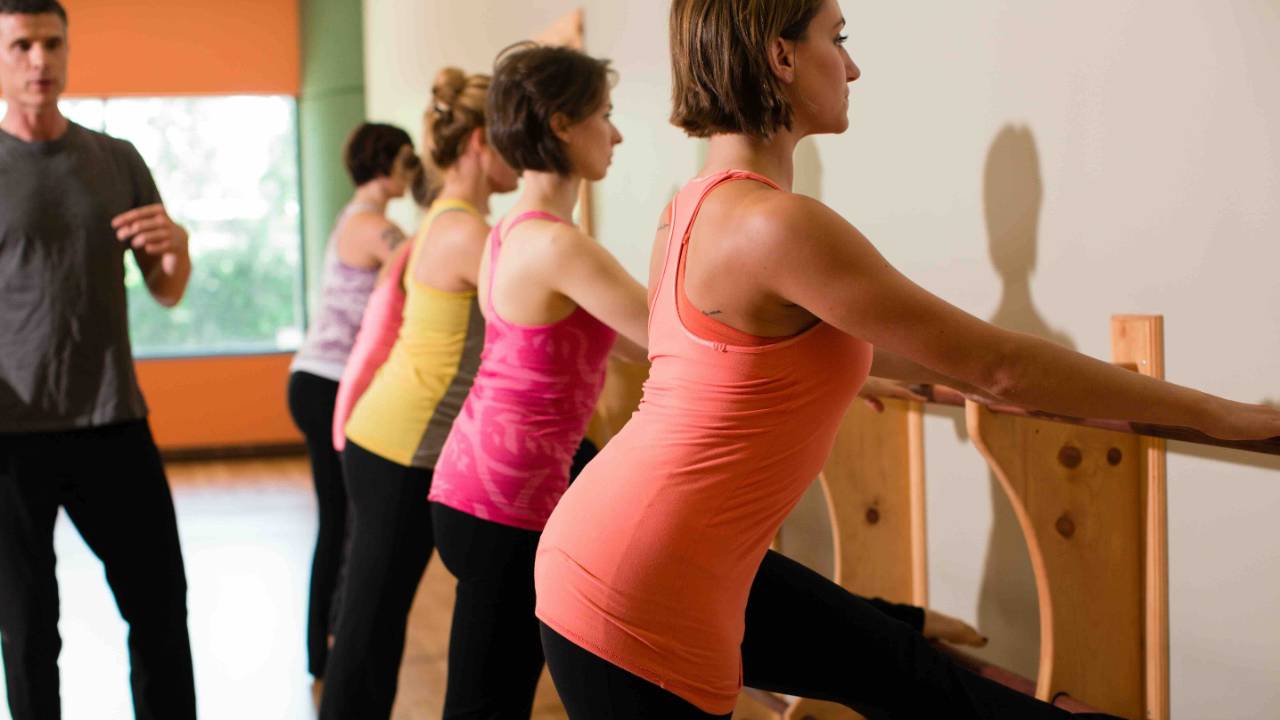
Spine Month
Twenty years of stretching and your hamstrings are still tight? They aren't short. They're holding on for a reason, and it isn't the reason you've been told. Read Jen's case study.
By Ana Kokaurova, Certified Advanced Rolfer®, Stott-certified Pilates instructor, VASIE® Instructor Trainer · October 12, 2026 · 9 min read
 The short version
Here is the surprising truth: stretching does NOT make a muscle longer. Researchers have known this since 2010 (and if you've been touching your toes every night for twenty years, you may have already suspected it!!). What stretching changes is your tolerance for the stretch, for a little while. So why do your hamstrings feel tight ALL the time? Because they are doing a job. Your hamstrings anchor right on your pelvis, and when the deep muscles that should stabilize your spine are slow or asleep, your nervous system grabs the hamstrings and HOLDS. That holding tucks your pelvis, flattens your low back (your natural shock absorber!!) and rounds your shoulders. That is the slump you keep catching in the store window, and no amount of "sit up straight" fixes it. So why do fitness programs keep telling you to stretch? Because a stretch feels good, right now. If you are here reading this, you probably already know that "feels good for an hour" is not the same as fixed. Let's dig in.
Tight hamstrings are usually a stability problem, not a flexibility problem. Give your spine a deep core that fires on its own, on time, and learn to move your legs WITHOUT your spine joining in, and the hamstrings finally let go. It takes a method, it takes slow precise movement, and it takes months.
The deep dive
Twenty years of stretching, and a back that still slumped
Jen came to Pilates 101 the way a lot of people do: a little skeptical, a little tired of her own body. Before we even got on the mats she told me the two things she tells every new trainer. "My hamstrings are SO tight, they always have been." And, "my posture is terrible, I know." She said it the way you'd mention your eye color. A fact. Not something that could change.
She is a nurse, a hiker and a skier, and she has been stretching those hamstrings every night for about twenty years. Foam rollers, yoga, a page of PT stretches she did every day for months. I hear this story almost every week in 101. What struck me about Jen is that she had done everything right, for a very long time, and she still couldn't touch her toes.
She still catches herself slumped in every store window. By the end of a twelve-hour shift her low back aches, and on a long hike she stops at every bench to "stretch it out." Every stretch helped. For an hour. Then the tightness came back, right on schedule, and so did the slump.
She came to Pilates 101 expecting a stretching class. She was a little annoyed when I told her we were going to do almost NO stretching, and that she HAD to take 101 before any regular class, even with all her years of yoga. But I had two things I wanted to check first: 1. Her breathing. 2. Whether her low abs and Kegel muscles could hold her pelvis still while her leg moved. If those two are off, I know the stretching will never stick, no matter how disciplined she is. As a fellow hiker, I really wanted her back on the trail without a hand pressed into her back. We are close in age, and I felt compelled to help her.
Jen is like many hikers, runners and nurses I have taught. But the tucked pelvis, rounded shoulders and "tight" hamstrings she walked in with are a pattern I can usually spot from across the room.
What stretching actually does
I have nothing against stretching!! I stretch. But here is what the research says it does, and it is not what most of us were taught. In 2010, two physical therapy researchers, Cynthia Weppler and Peter Magnusson, reviewed every study they could find on how stretching increases range of motion. Their conclusion: the gains from a few weeks of stretching come from a change in SENSATION, not a change in the muscle. The muscle doesn't get longer. Your nervous system gets more willing to let you go a little farther before it says "stop."1 Newer research has kept landing in the same place.
Think about what that means for Jen. Twenty years of nightly stretching, and her hamstrings never got longer because stretching doesn't do that. What she was doing every night was talking her nervous system into letting go, a little, for a little while. Then it changed its mind.
So if the muscle isn't short, then "tight" is a decision. Your nervous system is CHOOSING to hold those muscles firm. The real question isn't "how do I stretch this?" It's "why is my body holding on?"
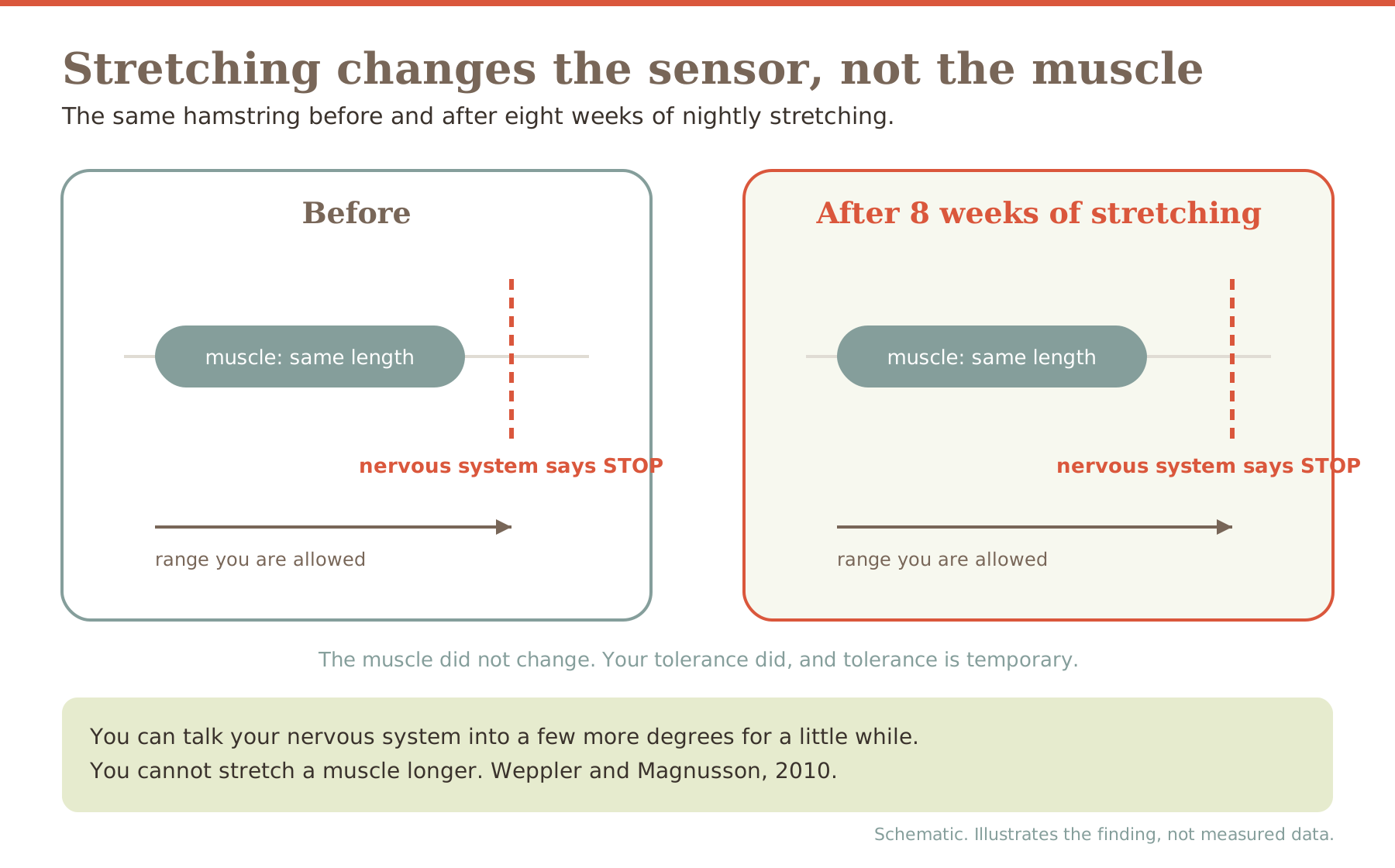 You can talk your nervous system into a few more degrees. You cannot stretch a muscle longer.
Why your hamstrings are holding on
Your hamstrings start at your sit bones, the two bony points at the bottom of your pelvis. That makes them some of the biggest, strongest muscles attached directly to the pelvis and, through the pelvis, to your lower spine. Keep that in mind.
Your spine is SUPPOSED to be stabilized by a different team. The transversus abdominis, the deep corset muscle that wraps your waist. The multifidus, the small muscles that hold each vertebra to the next. The pelvic floor and the diaphragm. These deep stabilizers are built to fire automatically, a split second BEFORE you move, so your spine is steady before the load arrives. Researchers in Australia showed back in 1996 that in people with low back pain, that deep muscle fires late.2 Not weak. Late.
When the deep team is late or asleep (after an injury, a pregnancy, years at a desk, or years of training the big muscles and skipping the small ones) your nervous system still needs a stable spine. It is not going to let you walk around with a loose one. So it borrows stability from wherever it can get it. And the hamstrings are PERFECT for the job: big, strong, and anchored right on the pelvis.
So they hold on. They pull your sit bones down and under, tuck your pelvis, and flatten the curve of your low back. Your upper back rounds to balance it. Your head drifts forward. That is Jen's slump in the store window, and it is the pattern I see in most "tight hamstring" clients: tucked pelvis, flat low back, rounded shoulders, and a person who has been told for years that she just needs to stretch more.
This is why "sit up straight" never lasts more than a minute. You aren't fighting a bad habit. You are fighting the muscles that are HOLDING YOU TOGETHER. And it is why stretching never sticks. A good stretch takes the brace away for an hour, but it gives your spine nothing in return. By morning your nervous system has grabbed on again, because it has to.
One of our clients, Natalia, said it better than any textbook: "Because I did not use proper muscles, other muscles took over and were overstrained, leading to pain and improper posture."
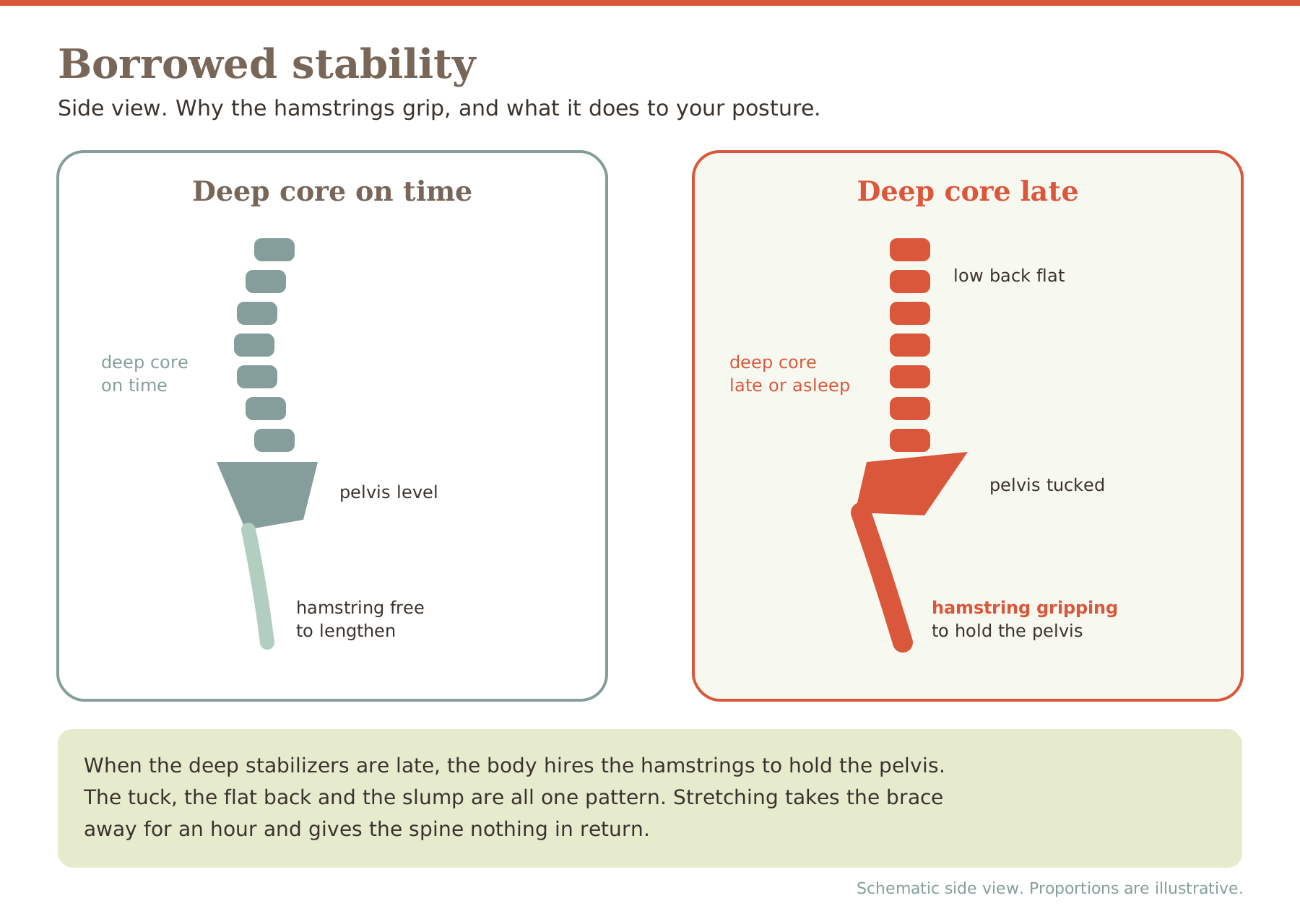 When the deep system is late, the body hires the hamstrings to hold the pelvis. The tuck, the flat back and the slump are all one pattern.
Stability makes length (the research says so too)
If the hamstrings are guarding, then the way to free them is to give the spine what it has been missing. And the research backs this up. In a 2009 study, a program of stabilization exercises for the low back, pelvis and hips reduced hamstring stiffness, with NO hamstring stretching at all.3 Physical therapists have a phrase for this: proximal stability for distal mobility. Stabilize the center, and the limbs are free to move.
Your body does this on its own when it is working well. Watch someone with a healthy walk: with every step, the pelvis stays quiet and level while the leg swings forward, and the hamstring on that side lets go to allow the swing. The deep core holds the pelvis so the hamstring is free to lengthen. Now watch someone with a tucked pelvis and "tight" hamstrings: short steps, a little shuffle, no swing. The hamstrings are too busy holding the pelvis to let the leg go. That is what we are retraining, and walking is where you will feel it first.
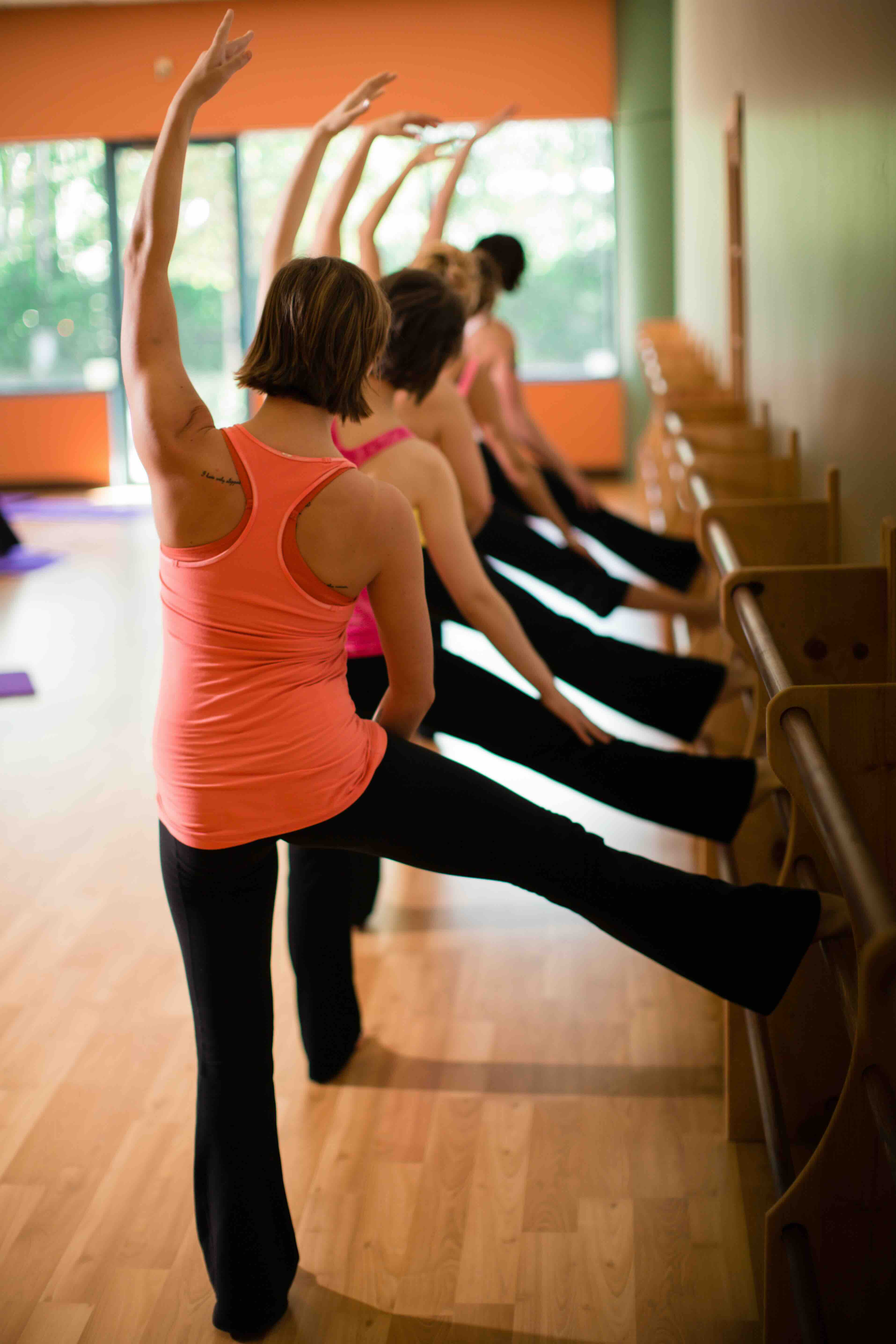
Stable center, free leg. The hamstring lengthens because the pelvis is held, not because it was stretched.
Try this at home: short or guarding?
This is what Jen and I did in her first Pilates 101, and it takes two minutes.
- Test. Lie on your back, both knees bent, feet flat. Straighten one leg along the floor. Keep it straight and lift it slowly until the back of the thigh says "stop." Notice where your foot is. Lower it.
- Steady the center. Bend that knee again. Press all ten toes gently into the floor. Breathe in through your nose. Breathe out SLOWLY through pursed lips, like you are blowing through a straw. As you exhale, lift your pelvic floor gently, the way you would stop the flow of urine. Small! Not a squeeze. Your neck, your ribs and your glutes stay quiet. Five slow breaths.
- Test again. On your next exhale, straighten and lift the same leg, slowly, the same way, and this time keep your pelvis absolutely still while the leg moves.
Jen's leg went higher. Noticeably higher. And she said the thing I will never forget: "Wait. My hamstring did NOT get longer in one minute... did it?!" Nope. It stopped guarding. Her deep core showed up for five breaths, her pelvis had something to hold it, and the hamstring was allowed to let go. In one minute she learned more about her "tight" hamstrings than in twenty years of stretching. After this I knew she was on the right track.
If your leg goes higher: congratulations, you just met the real problem. If nothing changes, that is useful too. It usually means the deep system isn't answering the breath yet, and that is exactly what we teach.
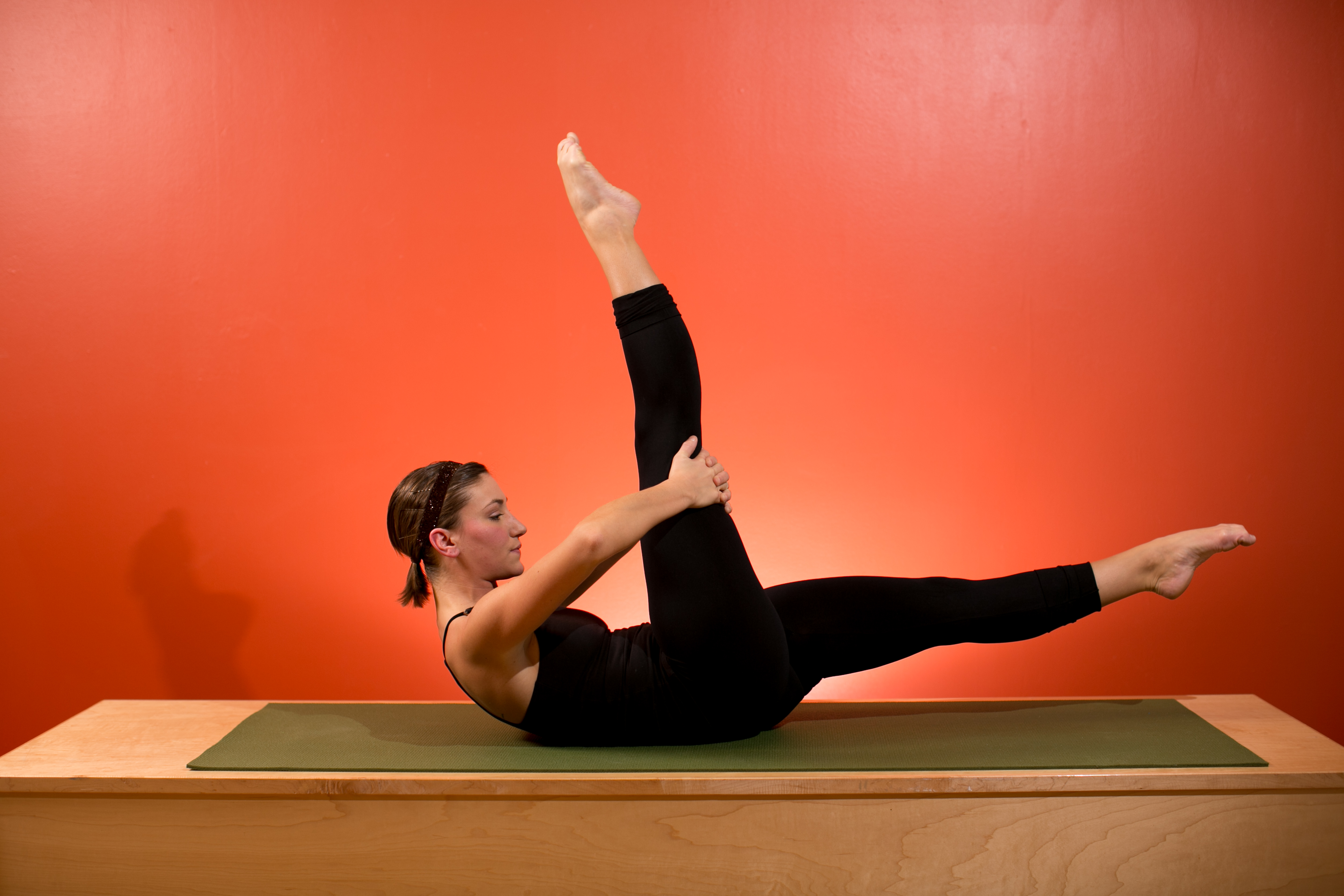
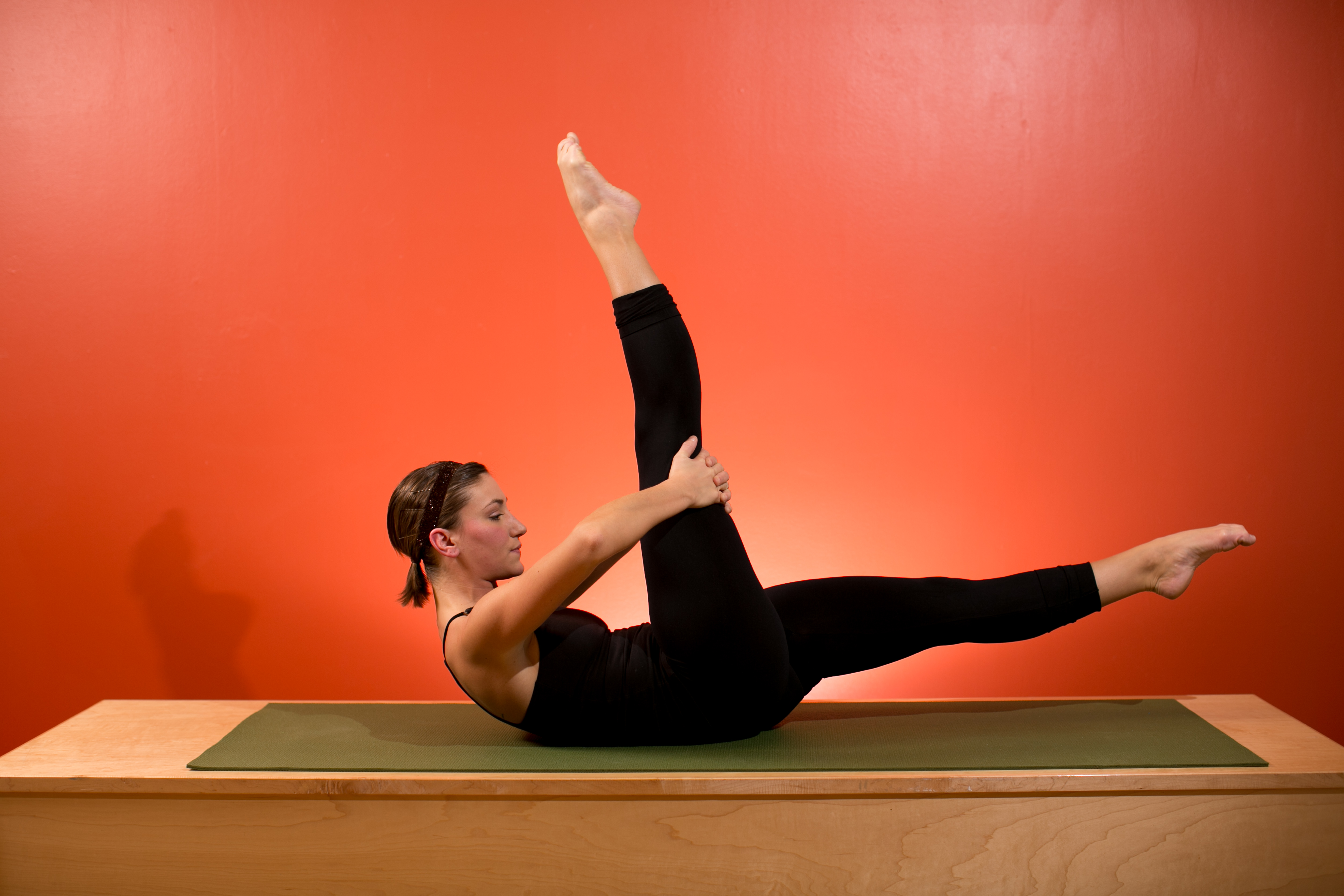 One leg moves. The pelvis does not. That is the whole skill.
BREATHlink: the way in
The second of the six VASIE® differences is BREATHlink, and it exists because of one fact: the deep stabilizers are NOT under conscious control. You cannot "engage your core" any more than you can decide to blink on purpose all day. Telling those muscles to squeeze just recruits the big surface muscles, which is more bracing, more guarding, more of the same. Most studios will tell you to engage your core. We will not, and this is why.
A few muscles sit halfway between voluntary and automatic: the lips, the diaphragm, the pelvic floor, and the feet and toes. Work those with precision (a slow exhale through pursed lips, a gentle pelvic floor lift, toes pressing into the floor) and the deep system starts answering on its own. You just did a version of it in the test above. That is BREATHlink.
The other half is speed. We move at the speed of your stabilizers, which is slow, because these small muscles shut down under heavy load and fast movement. Slow is not the easy version. It is the ONLY version where the right muscles get to do the work. And we spend a lot of time on one skill that sounds simple and isn't: moving your leg without your pelvis coming along. Your hip joint moving, your spine staying put. Every joint doing its own job. That is what stability and differentiation mean, and it is what stretching can never teach you.
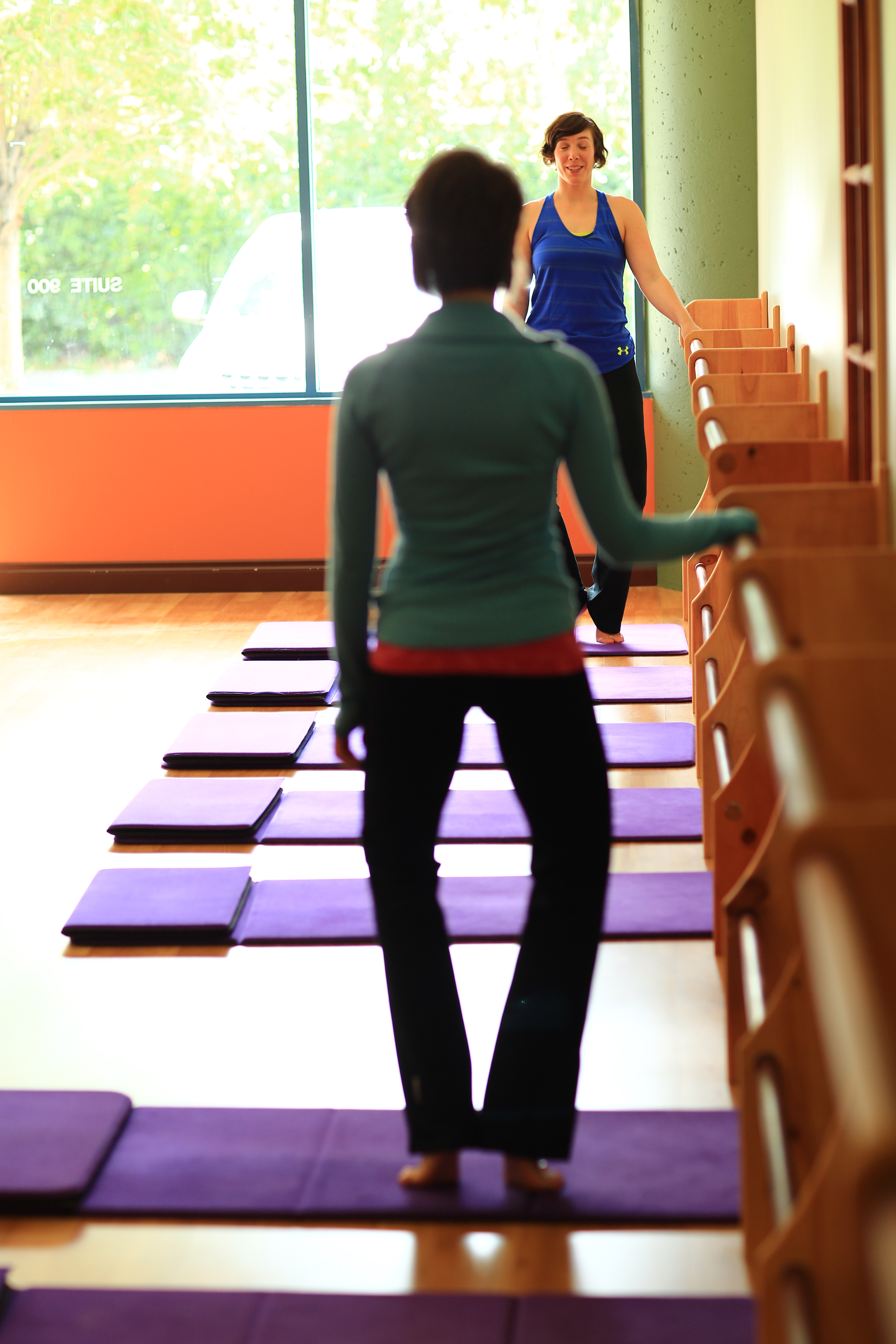
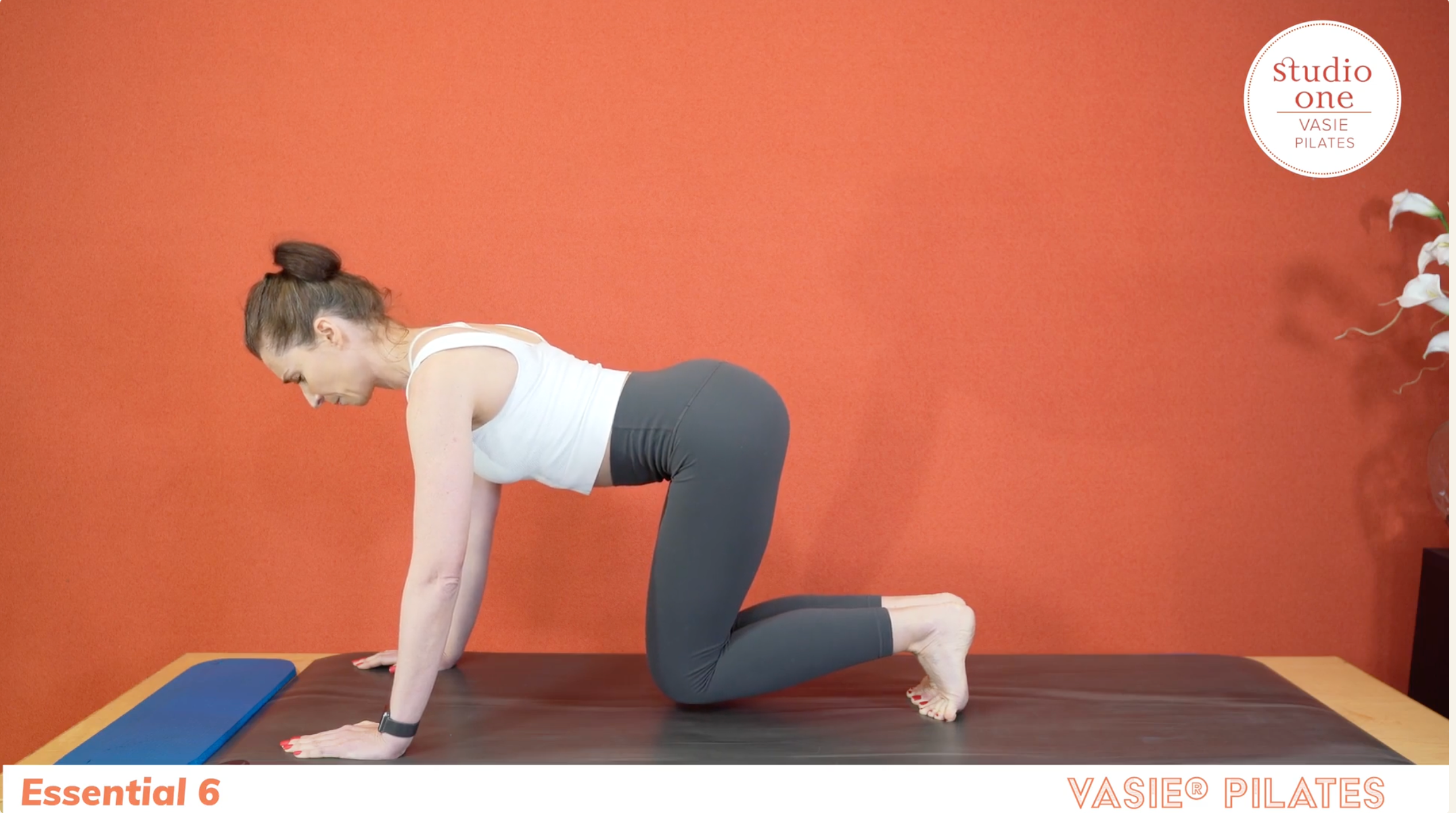
No music, no mirrors. Your teacher walks the room and watches your pelvis.
In class it looks like this. No music, no mirrors. Your teacher is not working out in front of you; she is walking the room, watching your pelvis, and putting her hands on you to show you what you can't feel yet. New clients start with Deep Core Toning, about eight to ten classes, before we add the strength and flexibility work. Stability first. THEN length.
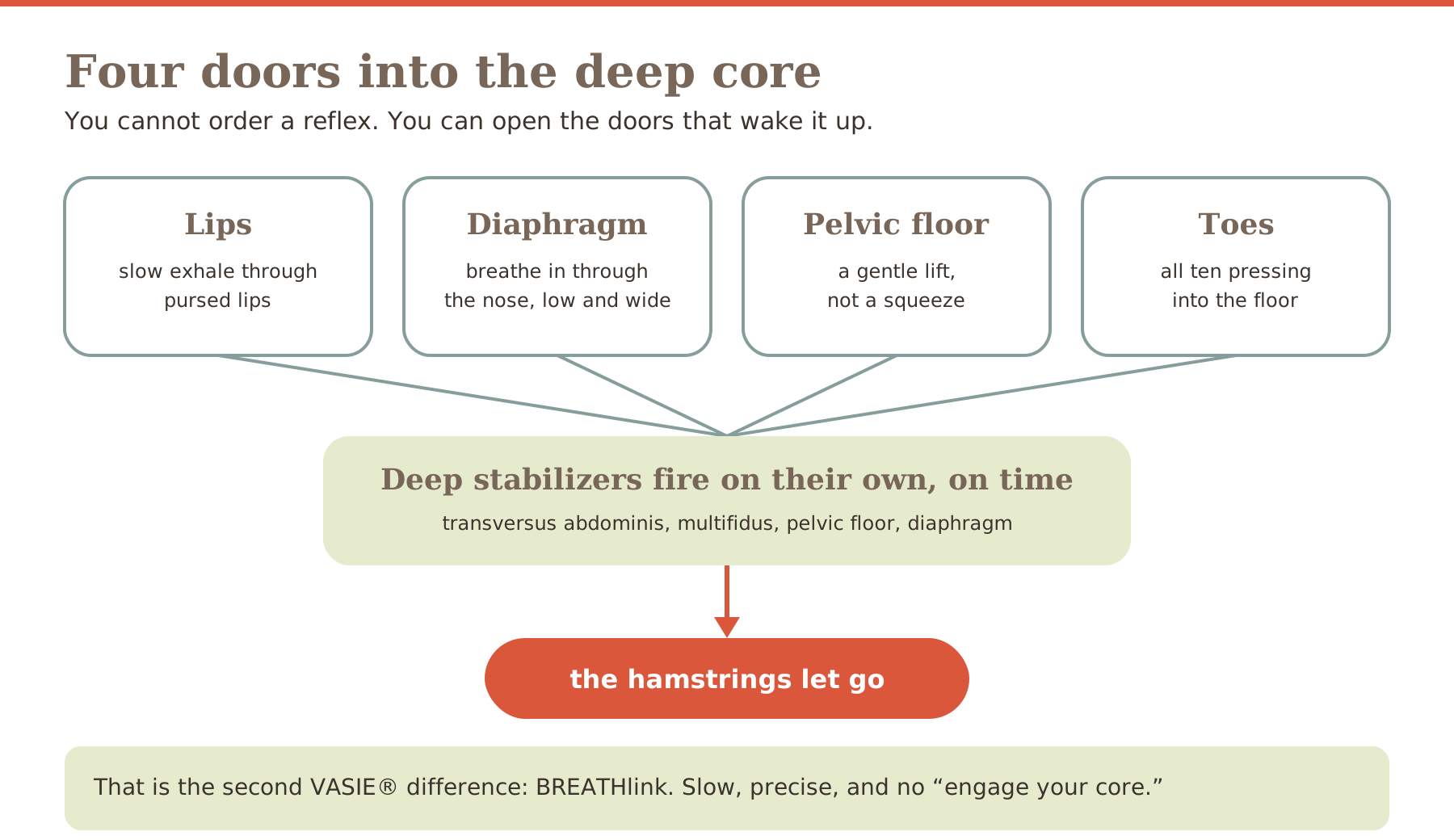 You cannot order a reflex. You can open the doors that wake it up. That is the second VASIE® difference: BREATHlink.
What changed, and what didn't
The first thing Jen had to unlearn was the nightly stretch-fest. Not forever! But for the first cycle she traded it for ten minutes of breathing, toe pressing and small leg movements with a still pelvis, which felt to her like doing nothing. It wasn't. It was letting the hamstrings stop so the deep muscles could be found. By week three she noticed her stride on the trail was longer and her back didn't ache by the second mile. By the end of her first sixteen-week cycle she was standing taller in the store window without thinking about it. At her six-month follow up she had done a twelve-mile day hike with a pack, no bench stops, no back pain. And she can touch her toes now. Mission accomplished.
What I told her at the start, and what I'll tell you: this is months. A nervous system that has been guarding for years does not hand over the job in a week. The good news is that it holds. Once the deep system is doing its job, the body keeps it, like riding a bike. And once your spine is stable, go ahead and stretch!! It will finally work WITH your body instead of against it.
One important note. If the tightness in the back of your leg comes with shooting pain, numbness, tingling, weakness, or any change in bladder or bowel control, see a physician before you see me. That can be a nerve, not a muscle, and stretching into it is the wrong move. Nothing in this post replaces the care of a physical therapist; several of the ones my clients see have helped shape these exercises.
What we've measured
Since 2000, more than 10,000 clients have trained in VASIE®. Across hundreds of two-week breath-based intensives we measured height and abdominal circumference before and after,* and analyzed posture on video. The average is over 3 inches off the low abdomen and three quarters of an inch of height. Nobody grows in two weeks. Height like that comes from a pelvis that stops tucking and a spine that stops slumping, which is exactly what happens when the hamstrings stop doing the deep core's job. And not one of those participants was told to stretch.
* Day one and day six of class, standing, after a normal exhale: low abdomen (hip bone to hip bone), waist, and lower rib cage. In-house measurements, not a controlled trial.
Find out whether your hamstrings are short or guarding
Studio One VASIE® Pilates
Pilates 101 is free, 90 minutes, and small enough that your teacher has her hands on your pelvis. You will do the leg test from this post with someone watching, and most people feel the difference in the first hour. You leave knowing WHY, with 20 to 30% off a membership if you want to keep going.
Book your free Pilates 101VASIE® Pilates Online
The free Flat Abs Fast mini course opens with a two-minute self-assessment. Lie on the floor, breathe, and find out whether your deep core is answering or your hamstrings have been doing its job. Then a 27-minute low-load session teaches you the stability that lets them let go.
Start the free mini courseAna Kokaurova is a Certified Advanced Rolfer®, a Stott-certified Pilates instructor, and a VASIE® Pilates Instructor Trainer. She has been teaching since 2000 and co-developed the VASIE® method — Van Alstine Structural Integration Exercise — which combines the principles of Rolfing® Structural Integration with the exercise system developed by Joseph Pilates.
References
- Weppler CH, Magnusson SP. Increasing muscle extensibility: a matter of increasing length or modifying sensation? Physical Therapy. 2010;90(3):438–449.
- Hodges PW, Richardson CA. Inefficient muscular stabilization of the lumbar spine associated with low back pain: a motor control evaluation of transversus abdominis. Spine. 1996;21(22):2640–2650.
- Kuszewski M, Gnat R, Saulicz E. Stability training of the lumbo-pelvic-hip complex influence stiffness of the hamstrings: a preliminary study. Scandinavian Journal of Medicine & Science in Sports. 2009;19(2):260–266.
Stay connected with news and updates!
Join our mailing list to receive the latest news and updates from our team.
Don't worry, your information will not be shared.
We hate SPAM. We will never sell your information, for any reason.