Why Kegels Can't Keep Up With a Surprise Sneeze
Oct 05, 2026
Low Abs, Glutes & Stability Month
After menopause, leaks are often a timing problem, not just a strength problem — and you cannot squeeze ahead of a laugh you didn't see coming.
By Ana Kokaurova, Certified Advanced Rolfer®, Stott-certified Pilates instructor, VASIE® Instructor Trainer · October 5, 2026 · 8 min read
The short version
The pelvic floor does not work alone. It is the floor of a pressurized cylinder whose lid is the diaphragm and whose walls are the deep abdominals and spinal muscles. In a well-organized body it tightens a fraction of a second before a cough or sneeze raises the pressure inside. When that timing slips — and after menopause it often does — strength alone can't cover for it.
Kegels build strength and are worth doing. Breath is how you rebuild the timing. The pelvic floor and the diaphragm move as a pair with every breath, and a slow, complete exhale is the most reliable way to teach the floor to answer on its own.
The deep dive
Ruth did her Kegels. Every day.
Ruth* is sixty-three, retired and she does not leave things undone. When she started leaking a little with a sneeze — a few years after menopause, and more so after a bad winter cold — she looked it up, found Kegels, and did them the way she had done everything in her life: on schedule, in sets, without missing a day. Eight months later she was measurably stronger. Her pelvic floor physical therapist confirmed it. And she still leaked when her granddaughter made her laugh.
"I did the work," she told me in her first class, with the particular frustration of someone who has always been able to fix things by doing the work. Ruth is a composite of several women I have taught in their sixties and seventies. The sentence is real and I have heard it many times.
She had solved the strength problem. Nobody had told her there was a second problem, and that the second one was the one causing the leaks
*not her real name
The pelvic floor is one wall of a pressure vessel
Picture the trunk as a cylinder. The respiratory diaphragm is the lid. The transversus abdominis — the deep corset muscle that wraps the waist — and the multifidus along the spine are the walls. The pelvic floor is the base. When you cough, sneeze, laugh, or lift, the pressure inside that cylinder spikes, and the base has to be firm at that moment or the pressure finds the weakest exit.
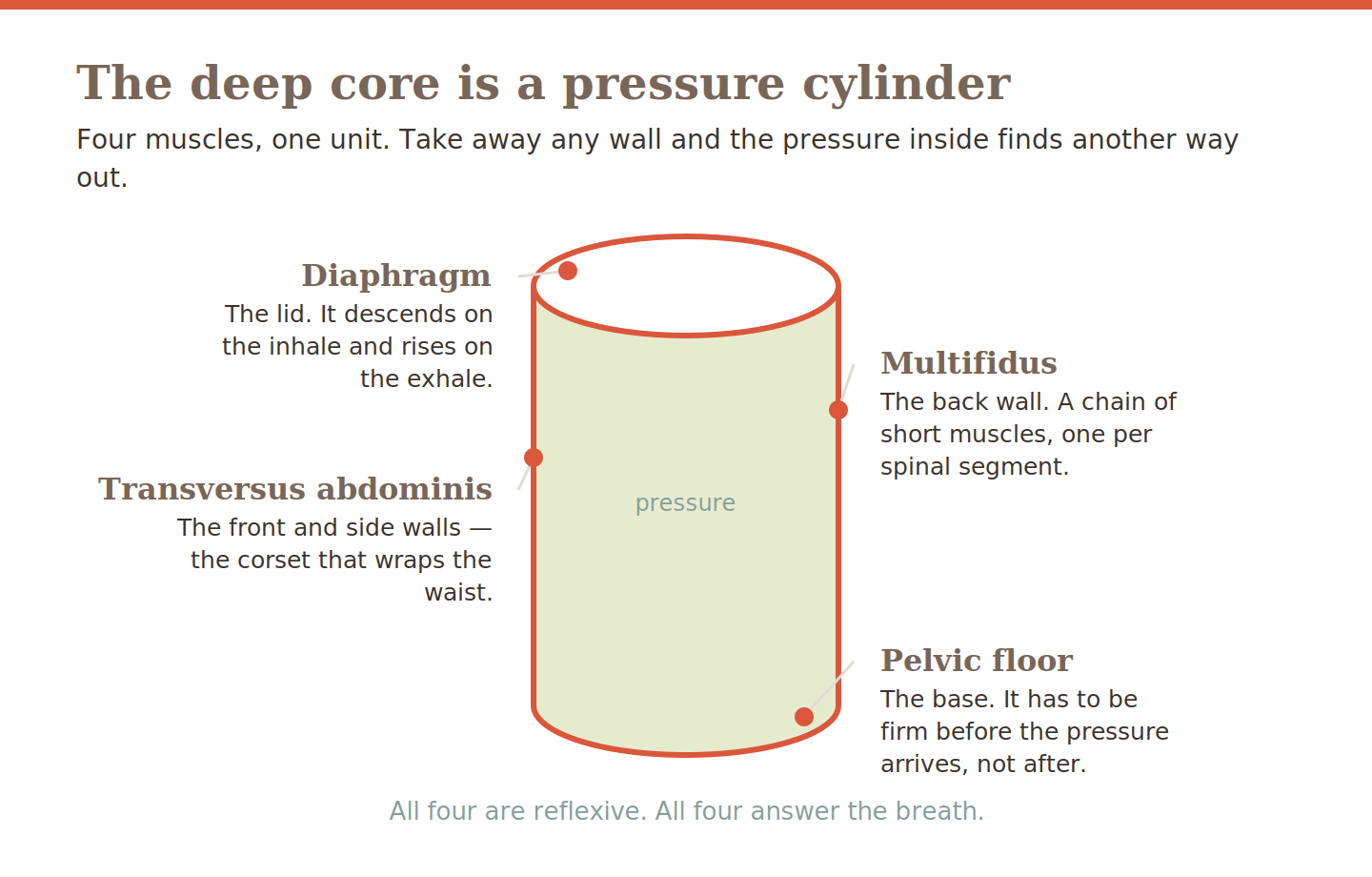
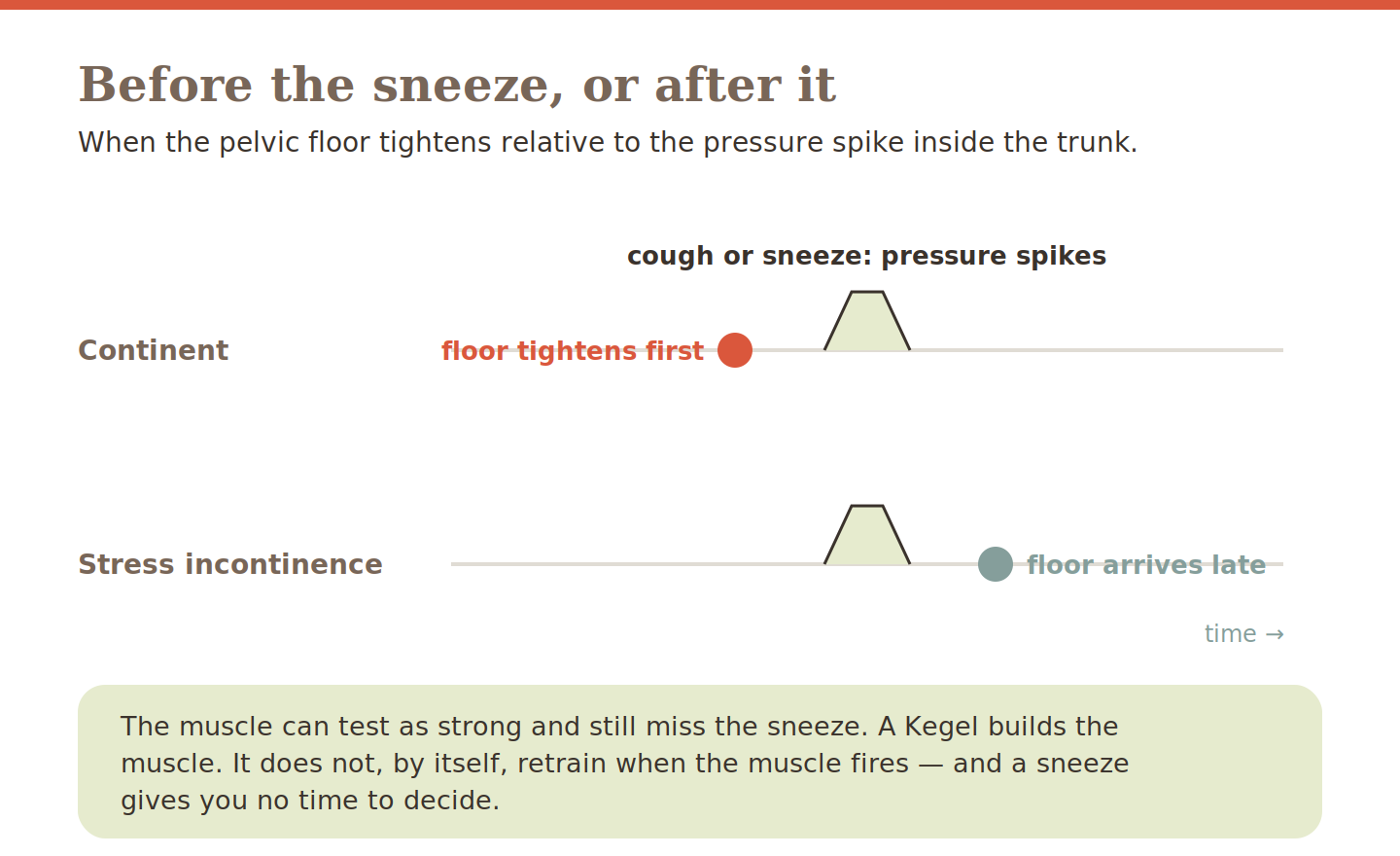
In women who don't leak, the pelvic floor contracts a fraction of a second before the cough — ahead of the pressure, not in response to it. In women with stress incontinence, that anticipatory response is often late or disorganized, even when the muscle tests as strong.1 The pelvic floor also co-activates with the deep abdominals: they are wired to work as a unit, and asking one tends to bring the other.2
This is why Ruth's Kegels worked and didn't work. A Kegel is a voluntary contraction. It builds the muscle. It does not, by itself, retrain when the muscle fires, and a sneeze gives you no time to decide.
What menopause changes, and what it doesn't
Estrogen supports the tissues of the pelvic floor, the urethra, and the connective tissue around them. When it declines, those tissues thin and lose some of their elastic recoil.3 That is real, and no exercise reverses it. If your physician has suggested local estrogen or other treatment, that conversation is worth having, and nothing I teach is a substitute for it.
But thinner tissue is exactly why timing matters more after menopause, not less. A pelvic floor with less passive support has less margin for arriving late. The muscle can be strong and still miss the sneeze. Ruth's problem was not that she was weak, or that she was old. It was that a reflex had gone quiet and she had been given a tool that doesn't reach reflexes.
The tool that does: breath
The second of the six VASIE® differences is BREATHlink, and it exists because of a fact about the pelvic floor that Ruth found surprising: it moves with every breath you take. As the diaphragm descends on the inhale, the pelvic floor descends with it. As the diaphragm rises on the exhale, the pelvic floor lifts. They are a pair, connected through the pressure inside the cylinder, and they have been practicing together roughly twenty thousand times a day for your whole life.4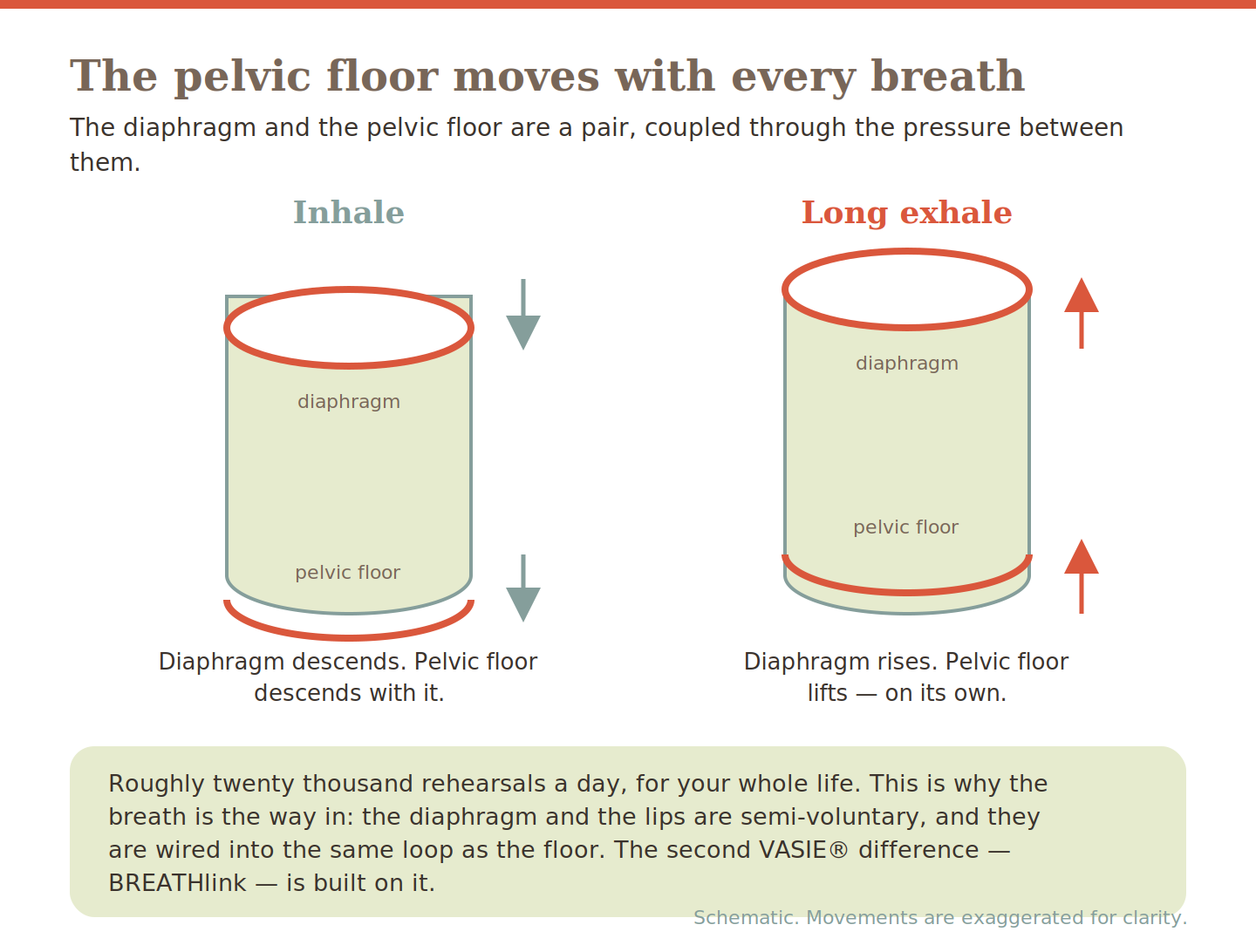 The floor lifts on the exhale on its own. That lift, repeated, becomes the reflex.
That makes the breath the way in. The pelvic floor is largely reflexive, but the diaphragm and the lips are semi-voluntary — you can control them, and they are wired into the same loop. A long, slow exhale through pursed lips, as if cooling soup, does three things at once. It keeps the diaphragm working through its full range. It recruits the transversus abdominis as part of forced expiration. And it lifts the pelvic floor at the end of the breath, gently, on its own schedule, without a Kegel.
The first time Ruth felt that lift arrive without her asking for it, she looked up from the reformer and said, "Oh. That's what it's supposed to do."
BREATHlinking, as we teach it, means moving at the speed of your stabilizing muscles — slowly enough that the floor, the walls, and the lid of the cylinder can stay coordinated through a movement. Repeat that in a hundred small exercises over a month and the coordination becomes the default. The floor starts arriving first, because the nervous system has been shown, many times, what arriving first feels like.
There is a bonus that Ruth cared about more than she expected. Slow exhalation raises vagal tone — the body's brake on its own stress response. Women in this stage of life often carry a great deal, and a breath practice that steadies the pelvic floor and steadies the nervous system at the same time is not a coincidence. It is the same muscle doing both jobs.
Keep the Kegels. Add the timing.
I am not going to tell you Kegels are wrong. There is good evidence that a deliberate pelvic floor contraction just before a cough — researchers call it "the Knack" — reduces leakage for many women,5 and strength you have built is strength you keep. If you have a pelvic floor physical therapist, keep seeing her. If you don't, and leaking is a regular part of your life, get one. Some pelvic floors are overactive rather than weak, and only an examination can tell you which you have.
What I am telling you is that the Knack is a plan for the coughs you see coming. The breath is a plan for the ones you don't.
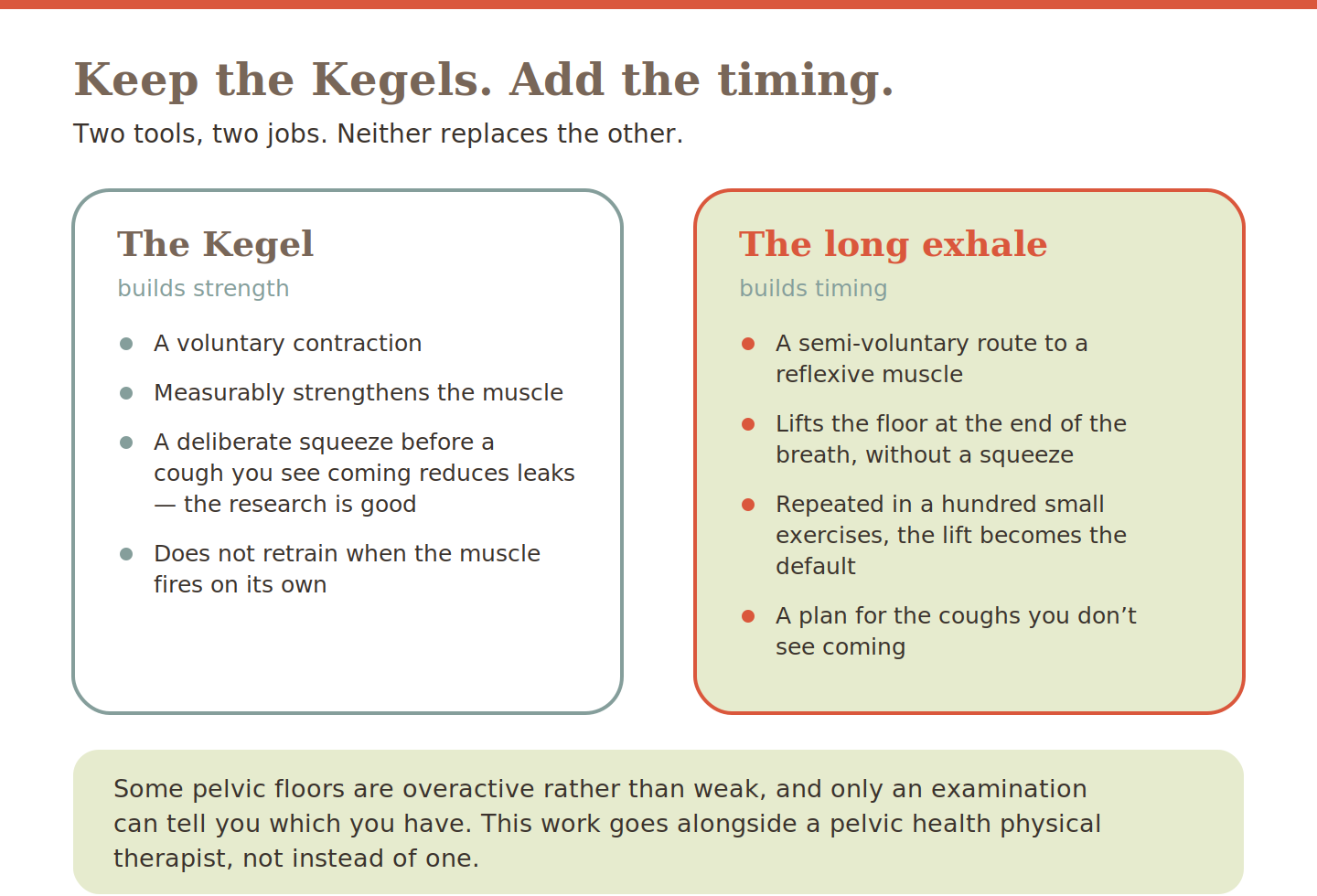 Two tools, two jobs. Neither replaces the other.
What changed for Ruth
Week two: she noticed she was exhaling longer at stoplights without deciding to, and that her lower back was quieter. Month two: the leaks with a sneeze stopped, though a hard laugh could still catch her. End of her first sixteen-week cycle: she went a full month dry, and told me she had stopped planning her outings around bathrooms. Her posture changed along the way — the same deep system that holds the floor also holds the spine — and she is half an inch taller by our tape than when she started.
She is still post-menopausal. Her tissue is what it is. What changed is that her pelvic floor answers before the pressure arrives, and that is a skill the body keeps. This is months of work, and I have never seen it happen in a week. It is also work you can do in your nineties.
"At age 75, I just hoped to slow the downward spiral. Never in a million did I guess that doing the foot and breathing exercises featured in VASIE Pilates Online would put back the spring in my walking. Plus my new and improved posture makes me feel and appear younger!"
Kathy Williams, client since 2021
What we've measured
VASIE® has been taught since 2000 to more than 10,000 clients and is grounded in current research on spinal stabilization, respiration, and pelvic floor health. Across hundreds of two-week breath-based intensives we measured height and abdominal circumference before and after,* with video movement analysis. Participants gained height and lost circumference in every abdominal dimension — the visible signature of a deep system that has come back online. Pelvic floor and physical therapists in our referral network have helped refine the breath work over the years.
* Day one and day six of class, standing, after a normal exhale: low abdomen (hip bone to hip bone), waist, and lower rib cage. In-house measurements, not a controlled trial. Continence outcomes are self-reported.
Learn the breath
Studio One VASIE® Pilates
Pilates 101 begins with the breath, and many of our students are in their sixties, seventies, and eighties. Every exercise is taught on the reformer, low-load, with an instructor watching.
Book Pilates 101VASIE® Pilates Online
The free Flat Abs Fast mini course teaches the exhale I described, with a two-minute self-assessment first. It is done lying down, at home, and the same breath that narrows the waist is the one that trains the floor.
Start the free mini courseAna Kokaurova is a Certified Advanced Rolfer®, a Stott-certified Pilates instructor, and a VASIE® Pilates Instructor Trainer. She has been teaching since 2000 and co-developed the VASIE® method — Van Alstine Structural Integration Exercise — which combines the principles of Rolfing® Structural Integration with the exercise system developed by Joseph Pilates.
References
- Deffieux X, Hubeaux K, Porcher R, et al. Abnormal pelvic response to cough in women with stress urinary incontinence. Neurourology and Urodynamics. 2008;27(4):291–296.
- Sapsford RR, Hodges PW, Richardson CA, et al. Co-activation of the abdominal and pelvic floor muscles during voluntary exercises. Neurourology and Urodynamics. 2001;20(1):31–42.
- Robinson D, Cardozo LD. The role of estrogens in female lower urinary tract dysfunction. Urology. 2003;62(4 Suppl 1):45–51.
- Hodges PW, Sapsford R, Pengel LHM. Postural and respiratory functions of the pelvic floor muscles. Neurourology and Urodynamics. 2007;26(3):362–371.
- Miller JM, Ashton-Miller JA, DeLancey JOL. A pelvic muscle precontraction can reduce cough-related urine loss in selected women with mild SUI. Journal of the American Geriatrics Society. 1998;46(7):870–874.
Stay connected with news and updates!
Join our mailing list to receive the latest news and updates from our team.
Don't worry, your information will not be shared.
We hate SPAM. We will never sell your information, for any reason.