Spine Month
Your chest dropped first. Your head followed. Why every neck exercise you've tried keeps wearing off, and the hinge in your mid-back that changes it.
By Ana Kokaurova, Certified Advanced Rolfer®, Stott-certified Pilates instructor, VASIE® Instructor Trainer · October 30, 2026 · 9 min read

The short version
If your head sits in front of your shoulders, you have probably been told to fix your neck. Chin tucks. Neck stretches. "Pull your shoulders back." And it works, for about a day. Here's why: your forward head didn't start at your neck. It started about four inches lower, at a spot in your mid-back we call the mid-dorsal hinge (right around your 12th rib, where your lower ribs meet your waist). When that hinge loses its lift, your chest drops, your upper back rounds to make room, and your head slides forward to keep your eyes level. The neck is the LAST thing to move, so it's the first thing everyone works on, and it never holds. So why does the fitness world keep selling neck fixes? Because the neck is where it hurts, and nobody can feel the hinge. If you are here reading this, you've probably done the chin tucks. Let's dig in.
The fix is spinal extension, done in order: a stable pelvis, low abs first, the lift starting from the feet and glutes, and the hinge waking up one rung at a time. Pilates has a whole ladder of exercises for exactly this, and the research says it beats working on the neck. It takes months. It holds.
The deep dive
Go stand against a wall. I'll wait.
Heels an inch from the wall. Hips touching. Upper back touching. Now, without lifting your chin and without arching your low back, let the back of your head touch the wall.
Did it? For a lot of people the answer is no, or only with the chin pointing at the ceiling, or only by pushing the low back into a big arch to get there. Notice where the effort came from. Notice how quickly you'd like to stop. That gap between the wall and the back of your skull is what everyone calls forward head posture, and I want to show you that it is not a neck problem.
Stay at the wall one more second. Put a hand on your breastbone. Now imagine lifting your breastbone an inch, straight up toward the ceiling, without arching your low back. Feel what happens to your head. For most people it floats back toward the wall on its own, with no neck effort at all. That is the whole post in one movement. The head follows the chest. The chest follows a hinge in your mid-back. And that hinge is where we are going to work.
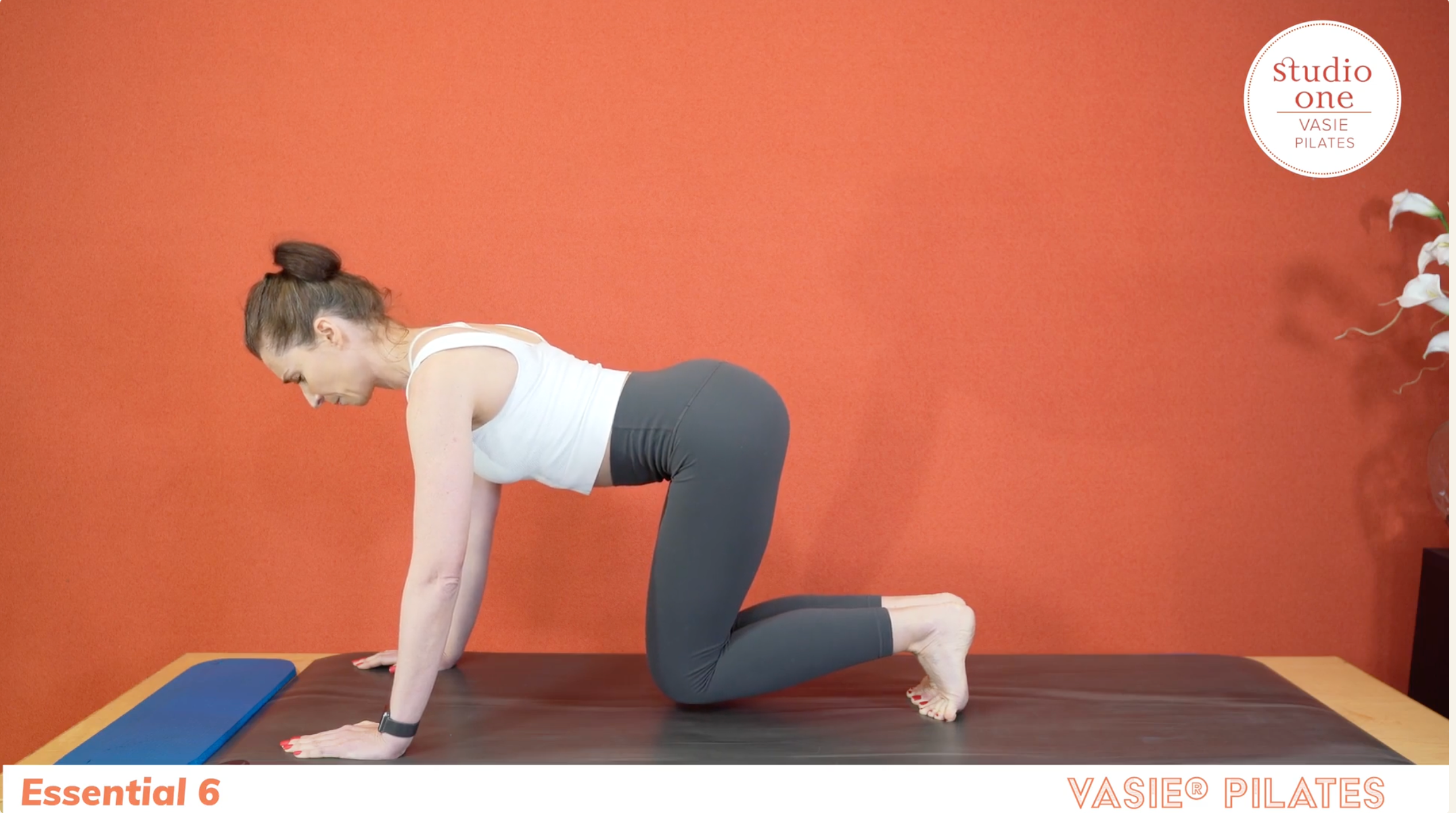
Watch Video and Follow Along: the first of the two free mid-back workouts
The hinge nobody told you about
Run your fingers down the middle of your back until you reach the bottom of your rib cage, roughly where your lowest ribs meet your waist. That's the junction of your lower thoracic and upper lumbar spine, around the 12th rib, and in VASIE® we call it the mid-dorsal hinge, or MDH. Our instructor manual calls it "the most important area to address for spinal extension in most adults," and the reason is simple: it is the pivot point of the whole upper body. When the hinge has tone and a slight lift, it holds your breastbone up and connects your shoulders to your pelvis and legs. It's the reason a healthy walk has that easy opposite-arm, opposite-leg swing.
Here is what happens to most of us. Years of sitting, driving, phones, and bracing the abs, and the muscles at the hinge lose their tone. The small joints there (the facets) get stuck in an open position. The hinge drops BACK, behind your pelvis. And now a chain reaction starts that you have never been told about: the chest wall drops. The rib angles change, so the ribs crowd together in front and spread apart in back. The upper back rounds to make room. And the head, which has to keep your eyes level no matter what, slides forward.
Our manual puts it in one rule I want you to remember: "Head forward posture typically starts with chest down and MDH back. Any change made to the head and neck will not last if the MDH is not corrected." Read that twice. It explains every chin tuck that wore off by Thursday.

The hinge drops back first. The chest falls. The head drifts forward to keep the eyes level.
Why neck work keeps wearing off (the research agrees)
I have nothing against chin tucks!! We teach a version of them, the micro neck imprint, and the deep neck flexors matter. But if the hinge below is still dropped, the neck is holding the head up against a chest that keeps pulling it forward. That is a job for the big, fast-fatiguing muscles of the neck and shoulders, and they get tired by lunch. You feel that fatigue as tension. You stretch it. It comes back. The hinge never moved.
In 2017 a research team tested this directly. They took people with neck pain and forward head posture and split them into two groups. One group worked on the neck itself: joint mobilization at the top of the neck plus neck retraction exercises, the classic chin tuck. The other group left the neck alone and worked on the UPPER BACK: mobilization and extension exercise at the top of the thoracic spine. Six weeks later, the upper-back group had improved their head position significantly more than the neck group, by about 3.9 degrees.1 The group that never touched the neck fixed the neck better. That is the rule from our manual, measured in a lab.
It holds up in older adults too, where the stakes are higher. A rounded upper back after 60 is linked to slower walking, worse balance and, in one long-running study, higher mortality.2 So a team in San Francisco ran a six-month randomized trial of spine-extension exercise and posture training in 99 adults over 60. The exercise group reduced the rounding of their upper backs by 3 degrees compared with the control group, which the authors note is about the size of the change caused by a spinal fracture, in reverse.3 Extension work changes the shape of a spine, at any age.

The group that left the neck alone fixed the neck better.
Why you can't just "arch your back"
So the fix is extension: bending the spine backward to wake up the hinge. But here is the catch, and it is the same catch as the last two weeks. Your spine bends where it is easiest to bend. Ask a body with a dropped hinge to arch, and the arch goes straight to the loosest spot, which for almost everyone is the very bottom of the low back, around L5. You get a pinch in the low back, a chest that still hasn't lifted, and the hinge still asleep. (If you have ever done a "cobra" and felt it only in your low back, this is why.)
The manual is blunt about it: "Safe spinal extension requires lumbar stabilization as its foundation." Without a stable pelvis, extension "will default to the path of least resistance." That is why every extension exercise in VASIE® starts in the same place: pelvis still, low abs first, the pubic bone pressing gently into the mat, and the lift beginning from the FEET and the GLUTES, not the back. The glutes are the unsung heroes of extension. With good tone and timing they lock the pelvis down, and the arch has nowhere to go but up, into the hinge, where we want it.
The sixth of the six VASIE® differences is systematic and predictable change, and this is it in action. We don't chase the symptom at the neck. We change the structure in a planned order, feet to pelvis to hinge to head, because the manual's rule tells us the order matters: fix the hinge and the head comes home on its own. Fix the head first and the hinge takes it right back.
Feel it: Small Extension 1
The wall told you whether your hinge has dropped. This tells you whether you can lift from it. It is the first rung of our extension ladder and the safest extension exercise in the system.
- Set up. Lie face down, legs long and together, feet pointed, fingertips alongside your thighs with palms toward the floor. Press your hip bones and pubic bone gently into the mat. That is your pelvis saying "I'm not moving."
- Hook up first. Inhale. Gentle lift of the pelvic floor. Exhale slowly through pursed lips, and as you do, press your feet and the backs of your legs down and together so the glutes switch on. Nothing above the waist has moved yet. Good.
- Lift. On the same exhale, let the lift travel UP from the glutes into your mid-back and float your breastbone an inch or two off the mat. Eyes down, back of the neck long. Small! Your chin does nothing. Your low back does nothing. Inhale and hold. Exhale and lower. Three times.
Now the reading. If you felt a pinch in your low back, the lift skipped the hinge and went to the loose spot; make it smaller, press the feet harder, start again. If your chin led the way, the neck took the job; eyes down. If you felt a broad, dull effort right at the bottom of your rib cage and your chest came up without your neck noticing, congratulations, that was your mid-dorsal hinge, maybe for the first time in years. That is the feeling we are going to build on all month.

Where the ladder leads: Swan Dive. The lift starts in the legs, and every vertebra shares the curve.
The extension ladder: what to do in class this month
We climb the spine one rung at a time, and each exercise wakes the hinge a little higher up. Here is the ladder, and how to get the most out of each rung.

Every rung starts the same way: pelvis stable, low abs first, feet and glutes begin the lift.
Small Extension 1, 2 and 3. Same exercise, three arm positions. Hands at the sides keeps it low and safe. Hands under the forehead moves the work above the hinge into the mid and upper back. Hands under the shoulders works the hinge itself and the upper thoracic spine. Your instructor will move you up when the rung below is clean. Three slow reps beat ten fast ones.
Chest Opener. This is the one to pay attention to, because it uses a trick that a normal backbend can't. Standing, hands on the barre, you lift the chest into extension and take a deep breath in. Then, on the exhale, instead of letting the chest sink the way it naturally wants to, you push it UP, further into extension, against the breath. We call it the paradoxical exhale. It builds a kind of sustained tone at the hinge that a simple lift can't reach, and it is the single most direct exercise we have for the muscles that hold your breastbone up.

Chest Opener. Inhale into the lift. Exhale and push the chest higher, against the breath.
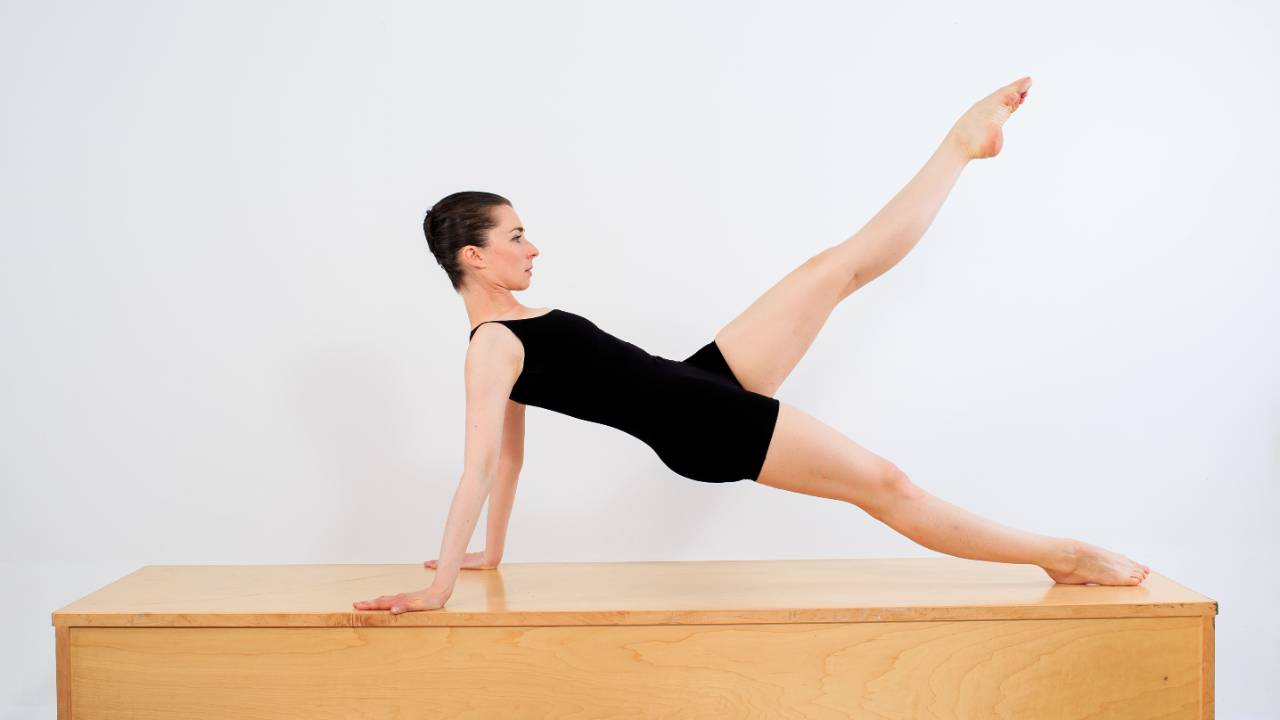
Leg Pull Prep. A chest opener with more leverage. Seated, leaning back on your hands, spine long. A very deep inhale with the eyes straight ahead and the chin slightly down (that gaze switches on the deep muscles at the front of the neck, which lift your top two ribs). Then the paradoxical exhale again: chest up as you breathe out. The legs and feet support you the whole time.

Leg Pull Prep. Deep inhale, eyes forward, chin slightly down. Then chest up on the exhale.
Swimming and Side Bend. Once the hinge can lift, it has to learn to HOLD while the rest of you moves. Swimming asks the spine to stay long and lifted while opposite arm and leg reach away. Side Bend Prep organizes the shoulders and the waist around a stable spine. These are where the new lift turns into a posture you can walk around in.

Swimming. The hinge holds its lift while the arms and legs move around it.
Three things to carry into every one of these. First: low abs before anything lifts, every single rep. Second: the lift starts in the feet and the glutes and travels up; if you feel it in your low back first, stop and start smaller. Third: eyes down or straight ahead, never up. The moment your chin leads, the neck has taken the job back from the hinge, and that is the exact habit we are retiring.

No music, no mirrors. Your teacher's hand goes on the hinge so you can feel where the lift is supposed to come from.
What to expect
Most people feel their chest come up in the first class, and a few notice the back of the head touching the wall that same week. That is real, but it is the nervous system finding the hinge, not the structure changing yet. The muscles at the hinge have to build endurance, and the facets that have been stuck open have to learn to close again, and that is months, in sixteen-week cycles. The research says the same: six weeks for a measurable change in head position, six months for a measurable change in the shape of the upper back. The good news is that it holds, because the hinge, once it lifts, is the thing holding your head up for you.
One important note. Extension is the safe direction for most backs, including most people with osteoporosis, and it is often the direction we send people when flexion isn't right for them. But if you have a disc herniation or an unstable low back, we do not articulate the spine in extension; we lift it up in one piece with the low back in neutral, and your instructor will show you how. If you have spinal stenosis, we keep the low back out of full extension. Tell us when you book. And if your neck pain comes with numbness or tingling in the arms, dizziness, or headaches that are new, see a physician before you see me. Nothing in this post replaces the care of a physical therapist; several of the ones our clients see have helped shape these exercises.
What we've measured
Since 2000, more than 10,000 clients have trained in VASIE®. Across hundreds of two-week breath-based intensives we measured height and abdominal circumference before and after,* and analyzed posture on video. The average is over 3 inches off the low abdomen and three quarters of an inch of height, and on video the shoulder and neck position moved toward neutral in most participants. Three quarters of an inch is roughly what you get back when a dropped hinge lifts and the chest comes up off the waist. Nobody in those classes did a single chin tuck.
* Day one and day six of class, standing, after a normal exhale: low abdomen (hip bone to hip bone), waist, and lower rib cage. In-house measurements, not a controlled trial.
Find the hinge, then lift from it
Studio One VASIE® Pilates
Pilates 101 is free, 90 minutes, and small enough that your teacher puts a hand on your mid-back and shows you exactly where the lift comes from. Most people feel their chest come up in the first hour. You leave knowing WHY your head sits where it does, with 20 to 30% off a membership if you want to keep going.
Book your free Pilates 101VASIE® Pilates Online
Wake Up Your Mid-Back is two free follow-along workouts built for the hinge behind your posture. The extension ladder from this post, taught slowly, on the breath, with the paradoxical exhale. Do the first one tonight and stand against the wall again tomorrow.
Get the 2 free mid-back workoutsAna Kokaurova is a Certified Advanced Rolfer®, a Stott-certified Pilates instructor, and a VASIE® Pilates Instructor Trainer. She has been teaching since 2000 and co-developed the VASIE® method — Van Alstine Structural Integration Exercise — which combines the principles of Rolfing® Structural Integration with the exercise system developed by Joseph Pilates.
References
- Cho J, Lee E, Lee S. Upper thoracic spine mobilization and mobility exercise versus upper cervical spine mobilization and stabilization exercise in individuals with forward head posture: a randomized clinical trial. BMC Musculoskeletal Disorders. 2017;18:525.
- Kado DM, Huang MH, Karlamangla AS, Barrett-Connor E, Greendale GA. Hyperkyphotic posture predicts mortality in older community-dwelling men and women: a prospective study. Journal of the American Geriatrics Society. 2004;52(10):1662–1667.
- Katzman WB, Vittinghoff E, Lin F, et al. Targeted spine strengthening exercise and posture training program to reduce hyperkyphosis in older adults: results from the Study of Hyperkyphosis, Exercise, and Function (SHEAF) randomized controlled trial. Osteoporosis International. 2017;28(10):2831–2841.
Stay connected with news and updates!
Join our mailing list to receive the latest news and updates from our team.
Don't worry, your information will not be shared.
We hate SPAM. We will never sell your information, for any reason.