
Why Bendy Bodies Feel So Tight — and How to Finally Feel Strong | VASIE® Pilates
Jul 24, 2026"The muscles that will hold you are already there. They are waiting to be woken up."”
If you have hypermobile joints, you have almost certainly been handed contradictory advice. Stretch more. Stretch less. Strengthen your core. Stop overdoing it. Most of it was well-meant, and most of it missed the real problem — because most of it treated your joints as the thing to fix. Your joints are not the problem. The system that organizes them is where the work lives: your muscles, your fascia, your breathing, and above all the nervous system that coordinates the timing of all three.
A quick, important boundary first. We are movement and structural-integration professionals, not physicians. VASIE® does not diagnose, treat, or cure any medical condition. Hypermobility can overlap with connective-tissue conditions such as Ehlers-Danlos syndrome that belong in the hands of your medical team. What we do is support joint health through intelligent exercise — always guided by, and deferring to, the recommendations of the medical field. Read this as education, and bring anything that concerns you to your doctor.
What Is Hypermobility — and Do You Have It?
Hypermobility simply means some of your joints move beyond the range considered typical. Generalized joint hypermobility is common; depending on how it is measured and who is measured, estimates range from roughly 2% to 15% of adults, and it is more frequent in younger people, in women, and in some ethnic groups1. For many people it is unremarkable — a party trick, a gift for dance or gymnastics. For others it comes bundled with pain, fatigue, clumsiness, and the sense that the body simply will not hold still.
A 30-Second Self-Check
Clinicians often start with a five-part screening questionnaire2. Answer yes or no:
- Can you now (or could you ever) place your hands flat on the floor without bending your knees?
- Can you now (or could you ever) bend your thumb back to touch your forearm?
- As a child, did you amuse friends by contorting your body, or could you do the splits?
- As a child or teen, did a kneecap or shoulder dislocate more than once?
- Do you consider yourself “double-jointed”?
Two or more “yes” answers suggests generalized hypermobility is worth exploring. This is a screen, not a diagnosis — only a qualified clinician can assess that. Symptoms people commonly report alongside hypermobility include joints that ache or “give way,” frequent sprains or subluxations, a paradoxical sense of stiffness, poor balance or coordination, fatigue, and a body that feels older than its years.
The Part No One Tells You: It’s in the Brain, Too
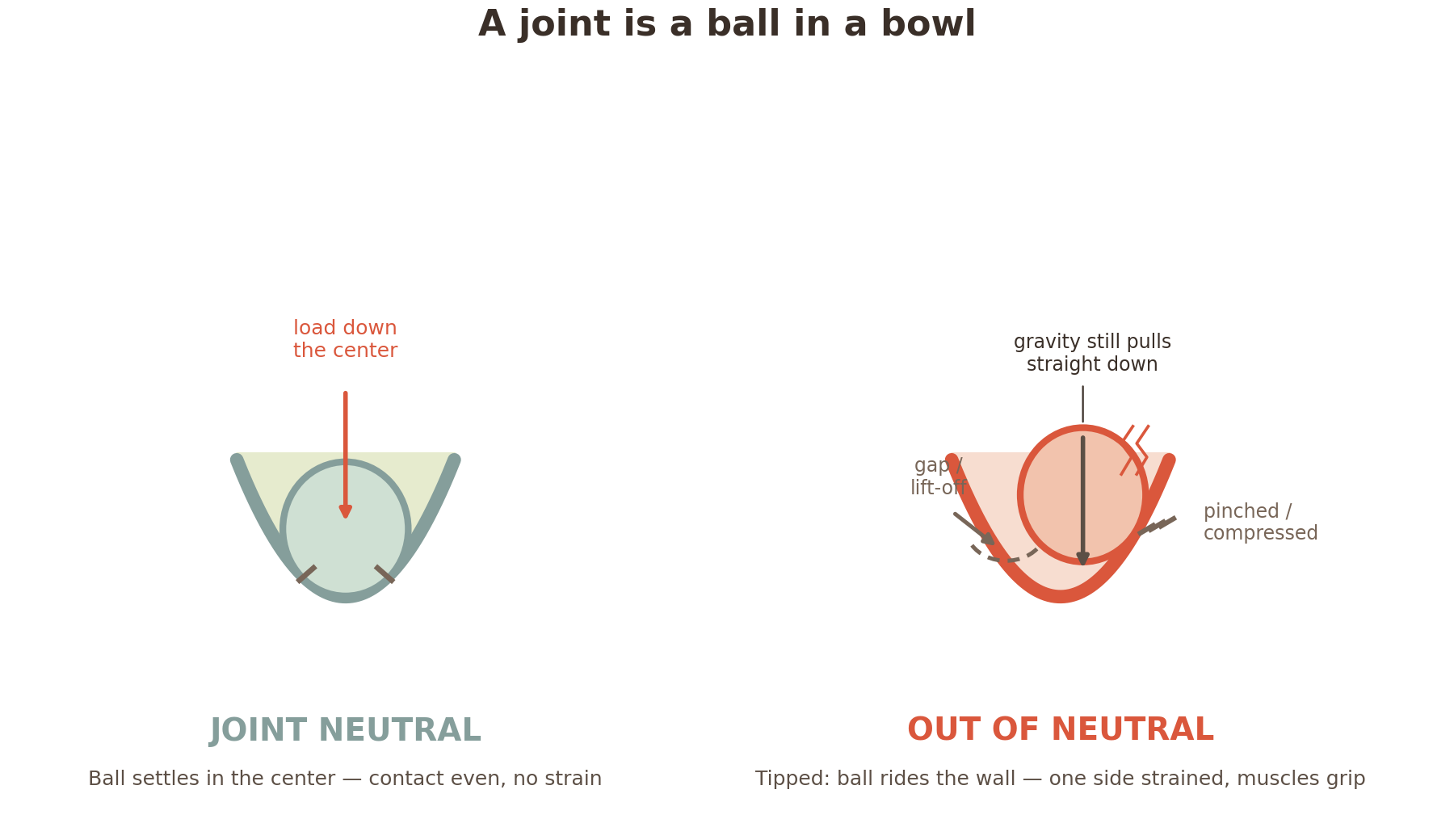
Here is the reframe that changes everything. Hypermobility is not only loose ligaments and stretchy connective tissue. It is also a proprioceptive difference — a difference in how well your brain senses where your joints are in space. The research is consistent: people with hypermobility tend to have measurably reduced joint position sense, especially in the lower limbs3. Your ligaments are the body’s position sensors; when they are lax, the signal they send upstairs is fuzzy.
This explains the great paradox of hypermobility: why so many bendy people feel stiff. When the brain cannot clearly feel a joint, and the joint moves too far, the body does the only sensible thing — it clamps down. Muscles grip to create a sense of stability the ligaments cannot provide. That constant low-grade guarding is exhausting, and it reads in the body as tightness. Excess motion in a joint also irritates the tissue, and irritation brings its own stiffness. The instinctive response — to stretch — is exactly backwards. Stretching a joint that is already too mobile loosens the very restraints you need. The job is not to lengthen. It is to tighten the lug nuts: restore tone, timing, and a clear signal.
Why Regular Pilates Isn’t Enough (and VASIE® Is Different)
Conventional Pilates can help a hypermobile body — but usually by accident, and only if you find an unusually perceptive teacher. Cue a bendy person to “reach long” and they will happily sail past neutral into their end range, reinforcing the exact pattern that hurts them. The problem was never a shortage of movement. It was the timing and source of stabilization.
VASIE® is intentional where other methods are incidental, and the lever is breath. Our BREATHlink technique uses the semi-voluntary system — the lips, diaphragm, pelvic floor, and feet — to reach the deep, involuntary stabilizers that no amount of “engage your core” can command directly. Breathing recruits the right muscles in the right order, so that stability arrives before movement rather than scrambling to catch up after. You are not unstable. You are stabilizing to move — from the wrong muscles, a beat too late. BREATHlink changes the timing.
How to Use the Program
Start with Deep Core Toning (DCT) mat classes. The whole point at this stage is to move slowly — slowly enough to stay inside neutral and hold tone the entire way — and to master BREATHlinking. Moving slowly is not a beginner’s limitation; it is the skill itself. BREATHlinking is the art of moving at the speed of your stabilizing muscles, which are far slower than the big “gym muscles” that want to take over.
Give particular attention to the joints that trouble you — but do not neglect the rest. This is essential: if you have loose joints, you almost certainly have areas that are too tight as well, compensating for the looseness elsewhere. The body works as a whole. Chasing only the joint that hurts is how people stay stuck for years.
The Golden Gate Principle
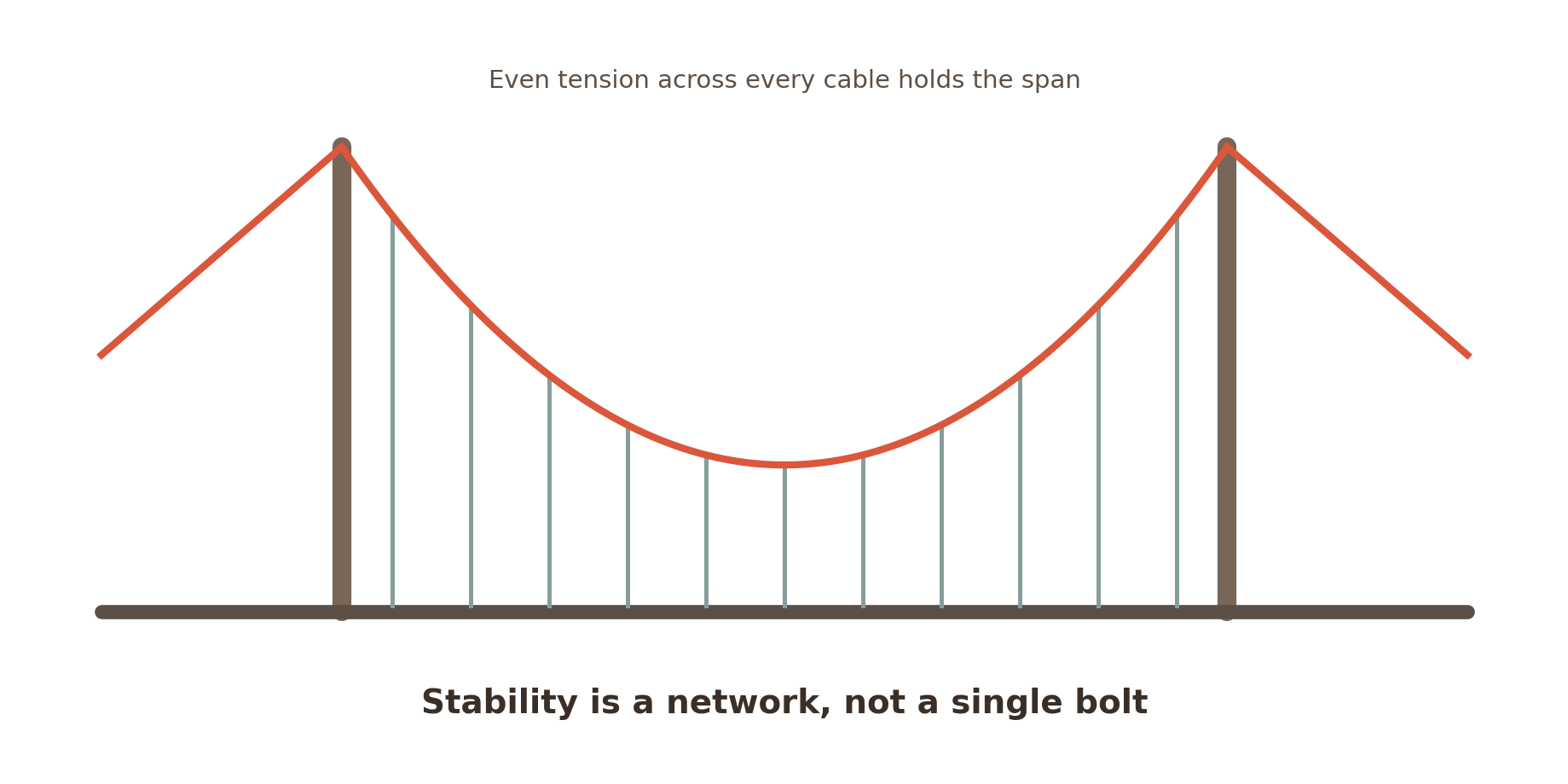
Think of a great suspension bridge. It does not stay up because one cable is cranked tight; it stays up because tension is correct and evenly distributed across every section. Over-tighten one cable and you introduce strain, not strength. Your body is the same. Bracing a single painful joint is like death-gripping one bolt — it fatigues, it fails, and it never lasts. Real stability is a network: tone shared across multiple joints, with the fascial connections between them trained to carry load together. Learning to stabilize across joints — and to strengthen the fascial lines that link them — is far more durable than stabilizing any one joint in isolation.
Stability Is a Nervous-System Project
Stability is not only mechanical; it is emotional. A body that never quite feels held lives in a low simmer of threat, and that has a real cost to mental health. Managing pain and unpredictability day after day is wearing. And there is a well-documented association between joint hypermobility and anxiety — first described decades ago and confirmed in long-term follow-up, where hypermobility behaved as a risk-factor trait for anxiety disorders4. Brain-imaging work points to shared wiring in regions such as the amygdala and insula that handle both bodily sensing and emotion5.
This is not a character flaw, and it is not “all in your head.” It is a nervous system doing overtime. The encouraging flip side: the same slow, breath-led work that steadies your joints also tends to steady you. BREATHlink increases vagal tone — a measure of how well the body downshifts out of stress — so that as your joints get quieter, so does your mind. Stability and calm are built with the same tool.
A Lifelong Maintenance Game — Like Brushing Your Teeth
Here is the honest part. If your connective tissue is the underlying reason your joints run loose, that tissue is not going to change its nature. Which means the muscular and neural work of holding your joints in neutral is not a course you complete — it is a practice you keep. Think of it the way you think about brushing your teeth: a small, non-negotiable daily habit that quietly prevents large problems.
That may sound like a burden. It is closer to a liberation. It means the outcome is genuinely in your hands: you can train your muscles to do the stabilizing your ligaments cannot, and you can keep re-training the nervous system’s proprioceptive map so the signal stays sharp. Miss a stretch of practice and, like any skill, some of it fades — but VASIE® changes tend to be “sticky.” The body remembers, and the work to return is far less than the work to build it the first time.
Where to Begin
Start slow. Start with the breath. Trust that moving at the speed of your deep stabilizers — rather than pushing into your impressive range — is the fastest route to a body that finally feels held. Bring your medical team along for anything that concerns you; we work best alongside them, never instead of them. And come to a Deep Core Toning class ready to do less, more precisely, than you ever have before. That is where stability is actually built.
Don’t chase the stretch. Tighten the lug nuts — evenly, patiently, for life.
- Tofts LJ, et al. “Generalized Joint Hypermobility in Adults: A Systematic Review With Meta-Analysis to Identify Data-Driven Cut-offs Using the Beighton Score.” Arthritis Care & Research, 2024/2025. Prevalence estimates vary with the cut-off and population used.
- Hakim AJ, Grahame R. “A simple questionnaire to detect hypermobility.” International Journal of Clinical Practice, 2003. The five-part self-report questionnaire (5PQ) is a validated screening adjunct — not a diagnosis.
- Smith TO, et al. “Do people with benign joint hypermobility syndrome have reduced joint proprioception? A systematic review and meta-analysis.” Rheumatology International, 2013. See also Scientific Reports, 2025, on joint position sense deficits at the knee and elbow.
- Bulbena A, et al. “Joint hypermobility syndrome and anxiety disorders,” 1988; and a 15-year follow-up cohort finding joint hypermobility to be a risk-factor trait for anxiety disorders. General Hospital Psychiatry / BMC Psychiatry.
- Eccles JA, et al. “Neural processes linking joint hypermobility and anxiety: key roles for the amygdala and insular cortex.” British Journal of Psychiatry; and related interoception research (Frontiers in Psychology, 2014).
This article is educational and does not constitute medical advice, diagnosis, or treatment. VASIE® Pilates supports joint health through exercise and defers to the guidance of qualified medical professionals. If you have or suspect a connective-tissue condition, consult your physician.
Stay connected with news and updates!
Join our mailing list to receive the latest news and updates from our team.
Don't worry, your information will not be shared.
We hate SPAM. We will never sell your information, for any reason.